
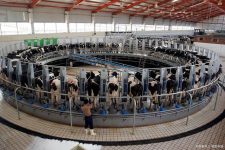
Automatic turntable type occupying milking table based on RFID technology
 chrispeng
 RFID Rotary Turntable Milking Systems: A Manufacturer’s Guide to Automated Dairy Identification
Dairy farms today face a two-sided challenge: global milk demand continues to grow, while skilled labor becomes more expensive and harder to retain. Rotary turntable milking parlors—often called carousel milking platforms—have become the answer for high-throughput dairies, allowing a single operator to manage dozens of cows simultaneously. However, a rotating platform alone only solves the problem of cow positioning. The truly difficult question is: how do you instantly identify each cow as she steps onto a moving platform, attach her milking session to the correct electronic record, and prevent repeated milking within the same shift?
RFID (Radio Frequency Identification) technology provides the most practical and reliable answer. It has long been used in livestock operations for automatic counting, intelligent weighing, and electronic herd-file creation in pig, cattle, and sheep farms. Today, RFID is widely deployed in milking stations to improve milking efficiency, traceability, and animal welfare. When integrated into an automatic turntable milking table, RFID turns what used to be a manually supervised process into a continuous, data-driven workflow.
Why RFID Is Fundamental to Modern Milking Parlors
RFID technology is not new to people working in modern pasture and dairy management. In its most basic form, an RFID reader communicates with an RFID tag through radio waves; the reader automatically retrieves the unique identifier stored in the tag. The operation requires no line of sight, tolerates dirt and condensation, and delivers reliable reads in seconds. In animal breeding management, an RFID electronic ear tag reader automatically captures the ear tag information worn by the animal, performs data transmission, and enables real-time monitoring of herd conditions. The result is an efficient, timely management system for every individual animal—whether cattle, pigs, or sheep.
The distinguishing advantage of RFID over legacy identification methods such as manual neck-band reading or barcode scanning is that RFID does not require a human to aim, trigger, or visually inspect anything. Once the animal enters a defined reading zone, data capture happens automatically. This is exactly the property a rotating milking environment demands, because stalls are moving and stall occupancy time is short.
Core System Architecture of an RFID-Equipped Rotary Milking Platform
A complete RFID solution for a rotary milking parlor involves far more than a single reader. From the perspective of an RFID manufacturer, the system architecture should be evaluated as four interactive layers: the animal-borne transponder, the fixed read zone, the controller, and the herd management software platform.
1. Animal-Mounted RFID Transponder
In dairy applications, the most common animal-borne transponder is an electronic ear tag. Each cow is implanted or fitted with an ear tag containing a unique ID code. This tag becomes the cow’s lifelong digital identity, enabling positioning, tracking, grazing management, feeding data collection, and milking access control. Ear tags must be durable enough to survive biting, rubbing against fence lines, weather extremes, and the chemicals used during cleaning in milking facilities. Therefore, farms should only select RFID tags designed for stringent livestock conditions rather than repurposed consumer-grade products.
Tag selection directly influences read reliability. In a rotary system, the reading distance typically ranges from 30 to 80 centimeters depending on the frequency band and antenna deployment. Low-frequency tags are widely preferred in cattle operations because they are less affected by water, mud, and dense tissue. Nevertheless, the physical structure of the tag and the quality of the encapsulation are decisive factors for long service life in the field.
2. Fixed Readers and Antenna System
Most rotary milking stations use a fixed read-zone structure rather than a handheld reader. In practical installations, antennas are deployed under or alongside each cow station. An electronic ear tag reader is mounted at a central control point and connected to multiple antennas. When a cow steps onto the rotating platform, the reader senses the ear tag through the antenna and automatically obtains the cow’s identification number. The cow number corresponds to that animal’s milking record one by one, which drastically improves the correctness and review efficiency.
One common misconception is that one antenna must be installed for every stall. In many installations, a multiplexed reader can cycle through many antennas quickly enough to track each platform position as it passes the entry point or the milking point. Whether a farm needs single-antenna-per-stall or multiplexed scanning depends on rotation speed and reader cycle time. For this decision, working directly with a qualified RFID reader manufacturer is advisable, as they can simulate channel count and read-cycle intervals based on the exact stall count and conveyor speed.
3. Real-Time Controller and Software Integration
An RFID reader alone does not manage a milking station. The reader output needs to be instantly delivered to the parlor controller, which coordinates the milking cluster attachment, the milk meters, and the automated exit gate. When a repeat visit is detected—for example, a cow re-entering within an unauthorized interval—the controller can direct that stall to be skipped or the exit gate to be opened immediately. This entire layer requires clean data communication through standard industrial interfaces such as RS-485, Wi-Fi, or Ethernet. Better-designed RFID readers offer flexible I/O controls and seamless protocol integration with parlor PLC systems, dramatically shortening installation time.
How the RFID Automatic Turntable Milking Table Works Step by Step
Understanding the operational sequence helps farm owners evaluate why the RFID turntable concept outperforms traditional static milking lines. The process runs as follows:
- Step 1: Cow identification at the entrance. As cows approach the rotary platform, the identification gate reads each ear tag before the animal steps onto the platform. This serves as an entry check and aborts the entry if the animal has already been milked within the required time window.
- Step 2: Stall-level confirmation. As the platform moves the cow toward the first working station, the in-stall antenna confirms that the expected cow is actually in that stall. The system then links the dynamically measured milk yield to the correct electronic cow file.
- Step 3: Individual milking data mapping. Each milk meter independently sends weight and flow data to the central controller. The controller records everything under the unique cow number identified by the RFID ear tag reader.
- Step 4: Post-milking decisions. The system decides whether to release the cow into a specific paddock, send her to a separate treatment area because of medical flags, or route her to another feeding zone. This is fully automated, no manual sorting needed.
Beyond milking number verification, the ongoing RFID data stream gives managers visibility into behavioral abnormalities. If a cow does not appear at the platform at her expected milking time, the herd management software generates an alert. Because the RFID readers operate 24/7, the production data becomes a powerful early indicator of health problems.
Technical Differences That Dictate Performance
One of the most important lessons for farm system integrators is that not all RFID products perform equally. Farmers evaluating a rotary milking installation should assess system performance beyond maximum read distance.
- Read rate and cow movement speed: A rotary platform at full speed presents a cow at the identification gate for only a few seconds. The reader plus tag combination must complete the reading in a fraction of this time. Low-frequency readers generally deliver very fast acquisition of single tags, which is sufficient for animal identification.
- Collision handling: Although a rotary parlor only needs a single tag in the field, the entrance lane may contain two or more animals close together. High-quality readers use anti-collision algorithms to ensure that only the tag inside the exact reading zone is captured.
- Environmental resistance: Milking halls are washed with high-pressure water and chemical disinfectants several times a day. The antennas and reader enclosures need IP67-rated waterproofing and corrosion-resistant housings.
- Integration flexibility: The output interface should not be a hindrance to existing farm software. In our experience, farms that insist on open-standard protocols reduce future data portability issues.
Product Selection Guidance for Dairy and Livestock Applications
Choosing the right components begins with a clear view of the biological, operational, and mechanical constraints. For a rotary turntable milking table, we recommend evaluating products from four angles.
Selecting the correct frequency band
Livestock identification systems mostly operate at low frequency (LF), usually 134.2 kHz, demonstrating excellent performance when tags are covered with mud, hair, or moisture. Meanwhile, UHF systems may offer longer reading distances, but are also more sensitive to the orientation angle of the tag and the reflections of the metal structure of a milking platform. For this environment, LF remains the safest option. The technical parameters of the frequency band—not marketing arguments—must determine the choice. Farms that are used to evaluating tag-level performance in other sectors, such as considering how existing consumers compare NTAG213 versus NTAG215 for NFC applications, should apply similarly strict comparisons to the chips and memory capacity of livestock ear tags.
Reader channel count and antenna multiplexing
Rotary parlors vary in stall count, from small 12-stall platforms to industrial 80-stall carousels. A correct deployment design defines how many antennas each reader handles and whether multiplexing time influences the rotation speed. When the milking table is large, distributed readers placed at multiple points around the carousel are usually preferable to one central reader with excessive cable lengths.
Form factor of the tag
Although the original system description uses ear tags, some farms equip newly acquired animals with rumen boluses, while others rely solely on visual and electronic ear tags. The form factor affects read distance and tag retention. Ear tags are easier to inspect and replace, while rumen boluses stay inside the animal for life and cannot be dropped accidentally in high-throughput situations. In any case, the tag must match the reader, otherwise even the most expensive hardware will fail in the field.
Supplier accountability
Because the milking parlor is a real-time operation, farms cannot afford offline components and slow product support at critical moments. Working with a supplier that manufactures both the tags and the read equipment reduces compatibility problems and assures farmers of a single point of technical responsibility.
Deployment Considerations in a Real Dairy Environment
RFID implementation is not a simple plug-and-play exercise. Based on years of manufacturer-level observations, we strongly suggest addressing the following factors before installation starts.
In-stall antenna placement
Antenna location has a decisive influence on read reliability. The antenna should be positioned so that the cow’s ear naturally passes through the strongest part of the magnetic field as she enters the stall. If the antenna is mounted too far away or positioned behind a thick metal plate, the read rate will be compromised. Usually, recessing the antenna into the platform floor or mounting it on the side rail at ear level yields the most stable results. Complete field testing with test tags should be performed prior to the commercial launch of the parlor.
Anti-repeated milking control
A key value of RFID in the automatic rotary milking process is to ensure each cow is milked no more and no less than the daily planned number. The software must instantly check the interval between the previous milking record and the current entry attempt. If this repeat-entry check is too slow, cows will already be standing on the platform before the system denies them, defeating the purpose of the identification procedure. For this reason, high-speed readers make a real difference in operator efficiency and cow traffic flow.
RFID data reliability outside the parlor
Even the best rotary platform performance will be disappointing if the cows cannot be identified when they leave the milking area. Sorting gates, feeding stations, and weighing points upstream and downstream of the parlor must also be equipped with compatible RFID readers. Designing one uniform tag standard for the entire breeding farm is the best strategy to avoid duplicated investment.
Quantifiable Benefits for Dairy Farm Operations
An RFID-based rotary milking platform moves the farm away from guesswork and toward verifiable numbers. Three categories of benefit stand out.
- Labor consolidation: The system improves manager and operator efficiency, reduces the labor input per ton of milk produced, and lowers labor costs. Instead of spending time looking at tags and checking log books, the operator can focus on udder health and machine cleaning.
- Consistent milk frequency: The system verifies every cow’s milking number per day in real time, proactively avoiding repeated milking events and also preventing cows from being accidentally missed. This directly affects herd production and udder health.
- Automatic and digital management: The turntable milking station becomes fully automated, digitalized, and information-based. Daily reports are generated automatically, veterinarians gain access to individual lactation trends, and nutritionists can adjust group feeding strategies based on objective data.
Industry Insights: The Broader RFID Ecosystem
The technical principles used for recognizing dairy cows are the same ones that power item-level track-and-trace systems in other industries. RFID’s ability to improve throughput without requiring line-of-sight has made it popular not only in livestock management but also in modern supply chains. For example, retailers increasingly apply ultra-high-frequency labels to apparel to manage inventory visibility across stores; similar principles of automated identification also support the effective implementation of RFID tags on clothes. In manufacturing, RFID readers verify that agricultural equipment parts, reusable containers, and mobile assets arrive at the correct processing station. What makes the technology so valuable across these sectors is the same in all cases: the information is captured automatically, quickly, in bulk, and under harsh operating conditions, without requiring human reading or manual data entry.
From a manufacturer’s point of view, the dairy sector remains one of the most demanding because of moisture, chemical cleaning, animal behavior, and the need for uninterrupted operation. Suppliers who successfully optimize for the milking parlor usually bring that durability knowledge to other RFID segments, raising the quality bar for all deployments.
Smart Farm Trends Beyond Milking
The RFID automatic turntable milking table is rarely deployed as an isolated solution. Farms that already possess RFID infrastructure tend to extend its use to automatic sorting by body weight, detection of lameness based on activity patterns, and feeding stations where each animal receives a ration tailored to its milk output. Integrated systems like these transform the dairy farm from a set of disconnected machines into a single intelligent operation. As dairy herds expand, the strategic value of data management will outgrow the value of the mechanical platform alone.
Frequently Asked Questions
1. What is the difference between the RFID ear tag reader used in a rotary parlor and a handheld reader?
A handheld reader requires the operator to consciously approach each animal and trigger a read. In a rotary turntable milking table, time is too short for this kind of manual process. Therefore, fixed readers with external antennas are installed at each cow station or entrance corridor to automatically capture data from passing animals. Handheld readers are useful only as a backup tool for handling cows that lose their tags.
2. How is reverse milking or repeated milking prevented in an RFID system?
The RFID reader identifies the cow when she enters the platform. The control software then compares the timestamp of this visit with the cow’s last milking time. If the interval is too short, the controller either prevents the cow from entering the platform or releases her through a rapid-exit route without moving the milking cluster into operating position.
3. Which frequency band is most suitable for automatic milking identification?
In most commercial dairy deployments, low-frequency (134.2 kHz) animal identification tags are used because they achieve excellent read consistency in dirty, wet conditions. UHF can be used in some feeding and sorting gates, but its longer read range increases the risk of reading the wrong adjacent animal in the tightly spaced rotary platform. Frequency planning should always be carried out with the equipment supplier at the design stage.
4. How many animals per hour can an RFID-equipped turntable handle?
This depends on platform size, the milking cluster duty cycle, and the parlor management software. Typically, a rotary platform with 40 to 60 stalls processes between 150 and 300 cows per hour. The RFID system is not usually the limiting factor, as its identification time is measured in milliseconds. The most important performance requirement is that tag reading speed must keep pace with the platform rotation speed.
5. Can an RFID rotary parlor be installed in an existing farm building with old equipment?
Yes. Many farms retrofit RFID to existing mechanical carousels and parlors. However, installation complexity varies depending on the metal structure, available wiring paths, and the software version of the existing controller. It is recommended to carry out an on-site technical survey and field read-zone test before making a purchase decision.
6. Is it necessary to use the same RFID tag and reader brand?
In theory, standards such as ISO 11784/11785 allow tags from one manufacturer to be read by equipment from another. In practice, cross-brand compatibility should be verified in advance, especially for longer read distances and high-speed applications. For critical operations such as milking, many farms prefer a single-source solution to avoid technical debates between different vendors when problems occur.
7. How long do animal RFID ear tags normally last?
A high-quality livestock ear tag should remain readable for the lifetime of the animal, often between five and ten years. Outdoor exposure, chemical resistance, and the mechanical robustness of the housing determine the tag’s real lifespan. Cheaper tags usually fail because of antenna breakage or damaged encapsulation, and each failure forces a labor-intensive replacement process.
Conclusion: The RFID-Backed Milking Platform as a Long-Term Strategic Investment
The automatic turntable type occupying milking table based on RFID technology is far more than a convenience device for the dairy parlor. It is a system that integrates the physical workflow of dairy cows into a digital management platform, enabling farmers to supervise every individual animal with consistent precision. Milking frequency is regulated, labor loads are reduced, and data is automatically distributed to every relevant part of the farm operation.
As the demand for dairy products increases worldwide, farms that maintain reliable automated identification will have the strongest position to scale efficiently. Whether upgrading an existing carousel or designing a new dairy complex, farm owners must treat RFID hardware as a core infrastructure component rather than an afterthought. The selection process should prioritize proven durability, seamless integration, and responsive technical support from a real RFID reader manufacturer. With the right components, the rotary milking parlor becomes both a high-throughput machine and a rich generator of usable production insights.