
 chrispeng
 How RFID Enables Intelligent Manufacturing and Production Visualization
The shift from traditional manual production monitoring to Industry 4.0 has placed unprecedented demand on real-time data visibility. As manufacturing processes become more complex and customized, original equipment manufacturers (OEMs) need technologies that can keep pace with high-speed production without compromising accuracy. Radio Frequency Identification (RFID) technology has emerged as a cornerstone of this transformation. Unlike barcodes, which require line-of-sight scanning, RFID leverages radio waves to automatically identify and capture data from a distance.
As a leading RFID reader Manufacturer, we design robust systems specifically engineered for industrial environments. RFID technology is not merely a replacement for barcodes; it is an evolutionary leap. It offers wireless read/write capabilities, batch reading, operation in harsh environments, and the ability to track assets in motion. This guide explores how RFID facilitates intelligent manufacturing and production visualization, providing a comprehensive look at the technology from the component level to full system deployment.
The Core Components of an RFID-Enabled Production Line
Building a reliable RFID system for a production line requires a combination of durable hardware and intelligent software. The main components include:
- Fixed and Handheld RFID Readers: These are the brains of the operation. Installed at strategic points along the assembly line, they continuously scan for nearby tags. Our portfolio of industrial RFID Reader units is designed for 24/7 operation, offering IP67 protection and support for dense reader environments.
- RFID Tags and Labels: Attached to products, pallets, or totes. The choice of tag depends on the material being tracked and the environment. For high-temperature paint shops or metal surfaces, specialized tags are required. General asset tracking often uses affordable RFID tag solutions.
- Antennas and Cables: These facilitate the communication between the reader and the tags. Circular polarized antennas are common for general use, while linear polarized antennas are better for orientation-specific reads.
- Middleware and Host Software: This interprets the raw RFID data and feeds it into the Manufacturing Execution System (MES) or Enterprise Resource Planning (ERP) software.
How RFID Enhances Production Visibility
Production visualization is the ability to see exactly what is happening on the factory floor in real time. RFID makes this possible by creating a “digital shadow” of the physical product.
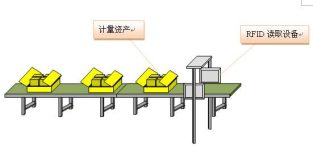
When a product or pallet with an RFID tag passes through a gateway (Reader A and Reader B in sequential stations), the system automatically logs the time, location, and status. This eliminates the need for manual data entry and provides live visibility into Work-in-Progress (WIP).
Data Collection and Transmission
Instead of relying on barcode guns which require a worker to stop and scan each item individually, RFID reads multiple tags simultaneously. For example, a pallet containing 50 components can be scanned instantly as it passes a doorway. This data is transmitted via Wi-Fi or Ethernet to the central host, allowing managers to monitor the flow of materials precisely.
Real-World Applications in Manufacturing
RFID technology is versatile and can be applied across nearly every manufacturing vertical. The primary goal is always the same: eliminate waste, reduce errors, and increase throughput.
Automotive Assembly
In automotive plants, cars are highly customized. RFID tags on the car body carry the “build sheet” of options (engine type, color, seats). As the chassis moves through the line, readers at each station trigger the correct robot or part kitting.
Apparel and Textile Manufacturing
The apparel industry is one of the fastest adopters of RFID. By placing specialized rfid tags on clothes, manufacturers can track garments from the cutting room to the sewing floor to finishing. This provides absolute visibility into production bottlenecks and ensures that the right inventory is shipped to the right customer.
Electronics Assembly
For sensitive electronics, RFID is used to track Printed Circuit Boards (PCBs) through soldering and testing phases. High-temperature RFID tags withstand the reflow oven, ensuring traceability is never lost.
Technical Architecture: How the System Works
Understanding the flow of data is critical for successful implementation. Here is the technical workflow of a typical RFID production line management system.
- Tag Initialization: Before production begins, an RFID tag is applied to the carrier (tooling board or material box). The system reads the unique Tag ID (TID) and binds it to the production order via the host software.
- Job Dispatch: Production information (name, part number, batch) is written to the tag through the reader at the start station.
- Process Validation: As the WIP arrives at a controlled station, the reader detects the tag. The system checks if the product is supposed to be there (Poka-Yoke / Error Proofing). If yes, the process instructions are displayed. The reader writes the process completion data back to the tag.
- Completion and Unbinding: At the final station, the reader reads the tag to verify that all required processes have been completed. If a step is missed, the system alerts the operator or redirects the product for rework. Upon successful completion, the tag is unbound from the product record, and the production barcode is stored as the permanent unique identifier in the database.
Product Selection Guidance
Choosing the correct hardware is essential for a successful deployment. Here are key factors to consider when selecting components for your production line.
Reader Selection
Consider the read range and communication protocol. Ethernet/IP or Profinet are common for industrial integration. For high-speed lines, choose a reader with high RF output and fast read rates.
Tag Selection
The tag must survive the environment. For metal assets, use on-metal tags. For high heat, use ceramic tags. For simple cardboard or plastic totes, standard RFID tag labels are sufficient.
NFC vs. UHF RAIN RFID
While UHF is standard for production lines (long range, high speed), there is a role for High Frequency (HF) NFC. For commissioning tools or allowing operators to pull up data using their smartphones, NFC is useful. When deciding on item-level interactivity, understanding the difference between ntag213 vs ntag215 helps in selecting the right memory size and security features for specific tooling or authentication needs.
Deployment Best Practices
Deploying an RFID system in a production environment requires careful planning.
- Site Survey: Conduct an on-site survey to identify sources of interference (large motors, metal racks, welding equipment).
- Antenna Placement: Position antennas to create a defined read zone. Avoid reading tags in adjacent cells by using shielding or directional antennas.
- Integration: Ensure the RFID middleware can communicate with your existing ERP/MES. Standard protocols like OPC-UA or MQTT simplify this process.
- Testing: Perform a pilot run to test read rates and accuracy before full rollout. Adjust RF power settings to optimize performance without causing interference with neighboring machines.
Frequently Asked Questions (FAQ)
1. What is the role of an RFID reader in an intelligent manufacturing plant?
The RFID reader acts as the data capture gateway. It energizes the tags, reads the stored data, and transmits that information to the control system. Industrial readers from a professional RFID Reader portfolio are built to withstand factory floor conditions.
2. Can RFID tags withstand high temperatures and harsh chemicals on the production line?
Yes. Specialized RFID tags are designed to withstand extreme conditions. For example, high-temperature tags can survive paint curing ovens, while chemical-resistant tags are available for wash-down environments. Partnering with a reliable RFID reader Manufacturer ensures you receive a complete solution that matches your environmental needs.
3. How does RFID production visualization differ from traditional MES data entry?
Traditional MES relies on manual scanning or operator input, which can be error-prone and slow. RFID automates this process, capturing data automatically when a product passes a station. This provides a real-time, accurate view of production status without human intervention.
4. Is RFID technology applicable to the apparel manufacturing industry?
Absolutely. The apparel industry relies heavily on item-level tracking. Placing rfid tags on clothes allows manufacturers to track individual garments through every stage of production, from cutting to packing, ensuring accuracy and reducing shrinkage.
5. What is the difference between HF (NFC) and UHF RFID in production lines?
UHF (Ultra-High Frequency) is used for long-range application (2-10 meters) and high-speed conveyor reading. HF (High Frequency/NFC) is used for short-range (0-10 cm) interaction, often for commissioning tools or secure authentication. In tooling management, understanding ntag213 vs ntag215 is important for selecting the correct NFC chip.
6. What is the typical Return on Investment (ROI) for implementing RFID on a production line?
While specific ROI varies, manufacturers typically see significant reductions in manual labor costs, a decrease in production errors (up to 80%), increased throughput, and improved inventory accuracy. The non-financial benefit of having full production transparency and traceability is equally valuable.
Conclusion
RFID technology is a critical enabler for intelligent manufacturing and production visualization. By automating data collection and providing real-time visibility into the production process, RFID allows manufacturers to respond quickly to issues, optimize workflows, and ensure product quality. From the automotive assembly line to the apparel cutting floor, the ability to track work-in-progress with absolute certainty transforms the manufacturing landscape.
To successfully implement this technology, it is vital to choose the right hardware for your specific application. By combining robust RFID tag solutions with high-performance readers, manufacturers can build a system that is not only reliable but scalable for future growth.