
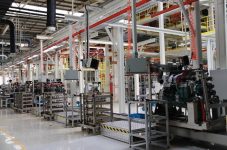
RFID technology helps domestic heavy-duty engine factories to liberate power and build smart manufacturing factories
 chrispeng
 RFID Technology Fuels Smart Manufacturing in Heavy-Duty Engine Factories: A Case Study in Productivity Transformation
Introduction
In late 2019, China’s first intelligent manufacturing plant dedicated to heavy-duty vehicle engines began full operation. This facility marked a critical leap forward for domestic heavy-duty truck engine production, leveraging RFID, DNC (Distributed Numerical Control), and other Internet of Things technologies to create an integrated smart manufacturing ecosystem. From an RFID manufacturer’s perspective, this case demonstrates how robust, field-proven RFID solutions enable real-time production data collection, algorithmic decision-making, and automatic feedback—transforming a traditional assembly line into a highly efficient, data-driven powerhouse.
Within the 50,000 square meter production area, one engine rolls off the assembly line every 110 seconds, yielding 130 engines per employee per year—a 117% increase over 2012 benchmarks. This article explores how RFID technology drives these gains and offers practical guidance for manufacturers looking to replicate such results.
The Role of RFID in Modern Heavy-Duty Engine Manufacturing
Real-Time Tracking and Data Collection
RFID tags attached to engine blocks, crankshafts, and other critical components enable automatic identification at every station. Unlike barcodes, RFID does not require line-of-sight scanning, making it ideal for high-speed, automated production lines. Readers installed along the assembly line capture unique IDs and transmit them to the factory’s MES (Manufacturing Execution System), providing an accurate, up-to-the-second view of work-in-progress. This real-time visibility allows supervisors to pinpoint bottlenecks, track cycle times, and enforce quality checks without manual intervention.
Integration with AGV and Automated Logistics
The factory’s intelligent logistics system relies on autonomous guided vehicles (AGVs) and automated overhead corridors. RFID readers mounted on AGVs read tags on pallets or bins, confirming load pickup and drop-off locations. This eliminates manual scanning errors and reduces logistics delays. Combined with a self-built three-dimensional warehouse and cold test SPS (Set Parts Supply) subsystems, the RFID-powered logistics network automatically delivers the right parts to the right workstation at the right time—improving logistics accuracy by 50% and significantly reducing inventory holding costs.
Technical Considerations for RFID Deployment in Engine Factories
Overcoming Metal and Interference Challenges
Heavy-duty engine components are predominantly metallic, which can detune standard RFID tags and degrade read performance. To address this, manufacturers should select on-metal RFID tags with specialized antenna designs that isolate the tag from the metal surface. Additionally, the presence of electric motors, welders, and other industrial equipment introduces electromagnetic interference. Ruggedized UHF RFID readers with adaptive frequency hopping and high-gain antennas are recommended to maintain reliable communication in harsh environments.
Selecting the Right RFID Tags and Readers
For engine blocks and crankshafts, high-temperature-resistant tags capable of withstanding paint ovens and heat treatment processes are essential. Passive UHF tags with IP67 or higher ratings provide durability against oil, coolant, and mechanical shock. When deploying on AGVs, angled-mount readers with extended read ranges (up to 10 meters) ensure consistent tag detection even during high-speed movement. For workstations, fixed-mount readers with integrated antennas can be embedded into conveyor systems for hands-free scanning. A well-designed RFID infrastructure must also include middleware that filters duplicate reads and integrates seamlessly with existing PLC and SCADA systems.
Real-World Impact: Performance Metrics from a Smart Factory
The intelligent manufacturing plant reported measurable improvements after implementing RFID and IoT systems:
- Production capacity increase – 52%
- Manufacturing cost reduction – 20.5%
- Logistics accuracy rate improvement – 50%
- Product defect rate decrease – 39.3%
- Energy consumption per unit output value decrease – 8%
- Annual cost savings – 21 million RMB
These figures underscore how RFID-driven automation and data transparency directly enhance operational efficiency. The 78% automation rate and 90% numerical control rate were achieved in part by replacing manual check-in and scanning processes with RFID-based tracking, allowing personnel to focus on value-added tasks.
Industry Insights: Scaling Smart Manufacturing with RFID
The heavy-duty engine plant’s success offers a blueprint for other industrial sectors. RFID is no longer a niche technology; it is a foundational layer for Industry 4.0 initiatives. In automotive and heavy equipment manufacturing, RFID enables:
- Condition-based maintenance – By tracking tool usage and machine cycles via RFID-tagged assets.
- In-line quality traceability – Every engine component’s history (batch, operator, machine parameters) is recorded for rapid root cause analysis.
- Flexible production – RFID allows mixed-model assembly without barcode changes, supporting quick changeovers between engine variants.
Manufacturers considering RFID deployment should start with a pilot on a single production line, focusing on high-value, high-volume parts. Key deployment factors include tag placement engineering, reader network layout, and middleware integration with ERP/MES. Partnering with an experienced RFID systems integrator can reduce trial-and-error and accelerate ROI.
Frequently Asked Questions (FAQ)
1. What RFID frequency is best for engine manufacturing environments?
UHF (860–960 MHz) passive RFID is most common for industrial tracking due to its long read range and high-speed data capture. For metal-heavy environments, use on-metal UHF tags that are tuned to compensate for detuning effects.
2. How does RFID improve quality control on the assembly line?
Each engine component is tagged with a unique ID. As the engine moves through stations, RFID readers verify that the correct part was installed and that process parameters (torque, temperature) were logged. Any deviation triggers an immediate alert, preventing defective engines from progressing.
3. Can RFID tags survive the high temperatures of engine paint ovens?
Yes. Specialized high-temperature RFID tags (rated up to 230°C or higher) are available for applications such as paint curing and heat treatment. These tags typically use ceramic or PPS housings and can withstand multiple thermal cycles without performance loss.
4. What is the typical ROI timeline for an RFID system in a heavy equipment factory?
Based on the case study, cost savings of 21 million RMB per year can be realized within the first two years after full deployment. Pilot projects often show payback in 6–12 months through reduced inventory, labor savings, and fewer defects.
5. How do you handle RFID interference from metal and machinery?
Choose on-metal tags designed for close metal contact. Use circularly polarized antennas that are less sensitive to tag orientation. Deploy readers with interference filtering and frequency hopping to avoid noisy channels. Site surveys with a spectrum analyzer help identify problematic zones.
6. What is the difference between RFID and barcode in engine manufacturing?
Barcodes require line-of-sight and can be damaged by oil or dirt. RFID can be read through non-metallic covers, multiple tags simultaneously (up to 200 tags per second), and is far more durable. In high-automation environments, RFID eliminates manual scanning delays and reduces error rates.
7. How many RFID readers are needed for a typical engine assembly line?
That depends on line length and station density. For a 50,000 m² plant with 100+ workstations, approximately 30–50 fixed readers combined with handheld units for exception handling are typical. AGV-mounted readers add 1–2 per vehicle.
Conclusion
The domestic heavy-duty engine intelligent manufacturing plant demonstrates that RFID technology is a cornerstone of modern industrial automation. By enabling real-time data collection, automated logistics, and seamless system integration, RFID helps manufacturers achieve dramatic improvements in capacity, cost, quality, and energy efficiency. For any factory aiming to build a true smart manufacturing facility, RFID should be considered not just an add-on but a strategic enabler. As the industry moves toward Industry 4.0, the lessons from this engine plant provide a clear, replicable path to liberation of power and sustained competitive advantage.