
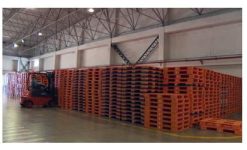
RFID pallet logistics transportation opens the door to “smart logistics”
 chrispeng
 From Pallet to Platform: How RFID Technology Transforms Pallet Logistics into Smart Logistics
In the rapidly evolving landscape of warehousing and logistics, the number of managed items is growing exponentially, entry and exit frequencies are soaring, and warehouse operations have become increasingly complex and diversified. Traditional manual warehouse operations and data collection methods can no longer meet the demands of modern logistics for speed, accuracy, and real-time visibility. The introduction of “palletized transportation” (also known as “carrying with pallet”) has accelerated the adoption of standardized pallets worldwide. When combined with RFID technology — which enables intelligent automatic identification and information collection — RFID pallet logistics transportation opens the door to what many call “smart logistics.”
RFID technology gives each standardized pallet a unique digital identity — an electronic “identity card” — thus creating a pallet information unit that can be tracked throughout the supply chain. This combination not only facilitates real-time tracking and management of pallet circulation (leasing, recycling, maintenance, storage) but also enables visual monitoring of palletized loads. The result is a dramatic improvement in the automation level of information collection in logistics management, enhanced cargo security during transit, higher logistics efficiency, and reduced operational costs.
Understanding Palletized Transportation and Its Global Significance
“Palletized transportation” refers to the method of assembling goods onto standardized pallets according to specific requirements to form a transport unit. This unit can then be easily handled using forklifts or pallet elevators for loading, unloading, consignment, and storage. Palletized transportation is recognized globally as one of the three major intermodal transportation methods — alongside container transportation and barge transportation. Surveys indicate that 80% of merchandise trade in the United States is carried by pallets, over 80% in the European Union, and 77% in Japan.
In China, the total number of standardized pallets reached 316 million units, with 17 million leased pallets — a year-on-year increase of 16.4%, indicating strong growth potential. For example, Guangdong Province, a major logistics hub, reported total social logistics of 19,724.695 billion yuan in 2016, accounting for 8.6% of the national total. The total social logistics cost was 1,177.395 billion yuan, representing 14.81% of GDP. Through standardization, leasing, and sharing of pallets, logistics costs can be significantly reduced. The path to pallet standardization is irreversible, and pallet sharing — powered by the sharing economy — is becoming the new norm, connecting pallet manufacturers, renters, logistics companies, and manufacturers in a collaborative ecosystem that reduces costs and improves efficiency.
The Role of RFID Tags in Pallet Identification
RFID technology assigns a unique, tamper-resistant identifier to each pallet. In pallet management, pallets are used repeatedly, and RFID tags — which can be read and written repeatedly — offer a cost-effective solution. The electronic tag attached to a pallet records the item code, while important details such as product name, quantity, volume, weight, shipping address, and destination are stored in a database accessible via the network. During transportation from origin to destination, a UHF RFID reader can read the tag at checkpoints, retrieve the required information at any time, and upload location data for both the pallet and the goods it carries.
This real-time visibility enables logistics managers to track goods directly, ensure cargo safety, and solve the persistent challenge of pallet tracking and recovery. The combination of RFID and pallet management makes pallet positioning, recycling, inventory management, and settlement intelligent, thereby reducing operating costs, promoting “Internet +” efficient logistics, and accelerating the formation of an open, shared, smart logistics ecosystem.
Technical Framework: How RFID Pallet Systems Work
Tag Selection and Placement
For pallet applications, RFID tags must withstand harsh environments — including temperature extremes, moisture, shocks, and repeated handling. RFID tags used on pallets are typically ruggedized and encapsulated for durability. Tags are often embedded into the pallet or attached to a designated location to minimize damage.
Readers and Antennas
UHF RFID readers with high read range (up to 10 meters or more) are deployed at key points: warehouse entrances/exits, loading docks, conveyor junctions, and sorting areas. Fixed readers with multiple antennas ensure reliable capture of all pallets passing through. RFID reader selection depends on the required read range, environment, and integration with existing warehouse management systems (WMS).
Data Integration
Data captured by readers is transmitted to a backend system (WMS or ERP) via wired or wireless networks. The system correlates tag data with shipment information, enabling real-time inventory tracking, automated dispatch, and exception handling.
Real-World Applications
- Automated Warehouse Entry/Exit: When a forklift carrying pallets passes through a dock equipped with fixed readers, the system automatically logs the pallet IDs, updates inventory, and verifies shipments.
- In-Transit Visibility: Pallet tags can be read at transit hubs, providing visibility into the location and condition of goods throughout the journey.
- Pallet Pool Management: Pallet rental companies use RFID to track pallet location, usage cycles, and maintenance schedules, reducing loss and improving utilization.
- Cold Chain Monitoring: RFID tags with temperature sensors can monitor perishable goods on pallets, triggering alerts if temperature thresholds are exceeded.
Deployment Considerations from a Manufacturer’s Perspective
As an RFID reader manufacturer, we recommend the following considerations for a successful pallet RFID deployment:
- Read Rate and Reliability: Ensure that readers can reliably capture tags even when pallets are stacked or moving at speed. Conduct site surveys to optimize antenna placement.
- Tag Durability: Choose tags with appropriate IP rating and impact resistance. For metal pallets or high-moisture environments, specialized tags may be needed.
- Integration with WMS: The RFID system must seamlessly integrate with existing WMS/ERP software. Middleware solutions can filter and format data.
- Scalability: Start with a pilot in one facility, then expand. Ensure readers and controllers support future expansion without replacing hardware.
- Cost-Benefit Analysis: Consider the total cost of ownership — tags, readers, installation, and software — against the savings from reduced manual labor, lower inventory errors, and faster throughput.
Product Selection Guidance
When selecting RFID products for pallet logistics, consider the following:
- RFID Tags: For standard plastic or wooden pallets, passive UHF tags with a read range of 3–8 meters are suitable. For reusable pallets, choose tags with high read/write endurance. For comparison, understanding the difference between NTAG213 vs NTAG215 may help if NFC-based pallet identification is also considered for shorter-range interactions.
- RFID Readers: Fixed readers with IP65+ rating and support for multiple antennas are ideal for industrial environments. Handheld readers can be used for spot checks.
- Antennas: Circularly polarized antennas offer better orientation tolerance for pallets passing through gates.
Industry Insights: Retail, Logistics, and Manufacturing
In the retail sector, RFID pallet tracking enables more accurate inventory visibility at the pallet level, reducing out-of-stocks and improving replenishment. In logistics, 3PL providers use RFID pallet systems to streamline cross-docking and reduce sorting errors. In manufacturing, RFID on pallets tracks work-in-progress movement between production cells, improving just-in-time inventory management. Across all industries, the shift toward shared pallet pools and IoT connectivity is accelerating, and RFID is the foundational technology enabling this transformation.
Frequently Asked Questions
Q1: What type of RFID tag is best for pallet tracking?
For most pallet applications, passive UHF RFID tags (860–960 MHz) are recommended due to their long read range, low cost, and ability to handle multiple reads simultaneously. For harsh environments, ruggedized tags with higher durability should be chosen.
Q2: Can RFID tags be reused on different pallets?
Yes, many RFID tags are rewritable, allowing them to be reused multiple times. This makes them cost-effective for pallet rental or pooling systems where pallets are returned and reassigned.
Q3: How does RFID improve supply chain visibility compared to barcodes?
RFID does not require line-of-sight scanning, can read multiple tags simultaneously, and updates information in real time. This drastically reduces manual labor and human error, and enables real-time tracking throughout the supply chain.
Q4: Is RFID suitable for cold chain pallet logistics?
Yes. RFID tags with temperature sensors can record temperature excursions during transit, ensuring compliance with cold chain requirements. Standard passive RFID tags also work in cold environments, though battery-assisted tags may be needed for very long-range or sensor-based applications.
Q5: How long does an RFID tag last on a pallet?
Passive RFID tags have no internal battery and can last indefinitely if not physically damaged. However, the read/write cycles may degrade over time depending on the chip specification. Good quality tags can withstand thousands of reads and years of use.
Q6: Can we integrate pallet RFID with an existing warehouse management system?
Absolutely. Most RFID reader manufacturers provide middleware and APIs (REST, SOAP, etc.) to integrate with popular WMS platforms. Custom integration services may be required for legacy systems.
Q7: What is the typical ROI for implementing RFID pallet tracking?
ROI depends on the scale of operations, but many companies see payback within 12–24 months due to reduced labor costs, fewer inventory errors, lower asset loss, and improved throughput. Savings from reduced pallet loss alone can be significant.
Q8: Are there any standards for RFID pallet tags?
Yes, the most common standard is EPC Gen2 (ISO 18000-6C) for UHF RFID. Many industries also adopt GS1 EPCglobal standards for data encoding to ensure interoperability across the supply chain.
The convergence of RFID technology with pallet logistics is not just an incremental improvement — it is a paradigm shift. By turning every pallet into a smart, connected node in the supply chain, businesses can achieve unprecedented levels of efficiency, transparency, and control. As the global logistics industry continues its march toward fully automated, intelligent operations, RFID pallet systems will remain a cornerstone of smart logistics.