
A comprehensive interpretation of NFC technology, so many application areas?
 chrispeng
 “`html
NFC Technology Explained: Working Modes, Chip-Level Architecture, and Deployment Strategies for RFID Manufacturers
Near Field Communication (NFC) has evolved significantly from its origins as a simple merger of RFID and network technologies. Today, it stands as one of the most widely deployed short-range wireless communication standards in the world — powering contactless payments, smart access control, logistics tracking, and interactive marketing campaigns. As an RFID tag and reader manufacturer, we offer this comprehensive technical deep-dive into NFC technology, its chip-level implementation, and the practical considerations for deploying NFC-based solutions across industries.
From a manufacturer’s perspective, understanding NFC is not just about knowing its communication protocols — it is about understanding how NFC tags, readers, and embedded secure elements work together to deliver reliable, secure, and scalable solutions. Whether you are integrating NFC into a mobile payment system, a retail inventory management platform, or a smart locker solution, the underlying principles remain the same. This guide walks through the full NFC landscape, from core specifications to real-world deployment strategies.
1. What Is NFC? A Technical Overview
NFC (Near Field Communication) is a standards-based short-range wireless communication technology that operates at the 13.56 MHz frequency band. It was originally initiated by NXP Semiconductors and jointly promoted by Nokia, Sony, and other industry leaders. Unlike traditional RFID systems that may operate over meters of distance, NFC is designed for proximity-based interactions, with a typical operating range of approximately 10 cm or less.
NFC evolved from the integration of contactless RFID technology with interconnection capabilities. A single NFC chip combines three distinct functions: an inductive card reader, an inductive contactless card, and peer-to-peer communication. This means a single device can read NFC tags, act as a virtual contactless card, or exchange data with other NFC-enabled devices.
The technology is standardized under ISO/IEC 18092, ECMA-340, and ETSI TS 102 190 frameworks, and it remains backward-compatible with widely deployed contactless smart card standards, including ISO/IEC 14443 Type A and Type B, as well as Sony’s FeliCa protocol. This compatibility is critical — it means NFC infrastructure can interoperate with existing contactless ticketing systems, access control readers, and payment terminals already installed globally.
NFC vs. RFID: Key Differences
While NFC is built on RFID principles, the two technologies are not interchangeable. RFID systems operate across a wide spectrum — from 125 kHz Low Frequency (LF) to 860–960 MHz Ultra-High Frequency (UHF) — and are designed primarily for long-range, high-throughput asset tracking. NFC, by contrast, is limited to the 13.56 MHz band and is designed for secure, close-proximity interactions involving user intent. The table below summarizes the key distinctions:
| Parameter | NFC | UHF RFID |
|---|---|---|
| Frequency | 13.56 MHz | 860–960 MHz |
| Read Range | < 10 cm | Up to 10+ meters |
| Data Transfer Rate | 106–848 kbit/s | 40–640 kbit/s |
| Communication Mode | Two-way (initiator/target) | Reader-talks-first (typically) |
| Primary Use Cases | Payments, access, data exchange | Inventory tracking, supply chain |
| Security Features | Built-in secure element support | Depends on tag IC and protocol |
For manufacturers, this distinction matters when guiding customers toward the right technology. If the requirement is high-speed pallet tracking through a warehouse portal, UHF RFID is the better fit. If the requirement is secure, user-initiated transactions such as contactless payment or digital keys, NFC is the clear choice.
2. Three Working Modes of NFC
NFC-enabled devices operate in one of three fundamental modes. Understanding these modes is essential for selecting the correct hardware components and designing the application architecture.
2.1 Card Emulation Mode
In card emulation mode, the NFC device behaves exactly like a contactless smart card. The NFC chip communicates with an external reader using standard ISO/IEC 14443 protocols, without requiring the host device’s processor to be actively involved in the transaction. This mode is the foundation of mobile payment systems, digital ticketing, access control, and loyalty card applications.
Card emulation is particularly powerful because it allows a smartphone to replace multiple physical cards. A single device can store credit cards, transit passes, building access credentials, and membership cards — each emulated as a separate secure element applet. The secure element, which may be embedded in the phone’s hardware, on the SIM card, or in a cloud-based HCE (Host Card Emulation) environment, provides the cryptographic processing required for secure transactions.
2.2 Peer-to-Peer (P2P) Communication Mode
Peer-to-peer mode enables two NFC-enabled devices to exchange data bidirectionally. When two devices are brought within close proximity, they automatically establish a connection and begin transmitting data. This mode follows the NFC Forum’s Logical Link Control Protocol (LLCP) and can support data transfer rates of up to 424 kbit/s.
Typical P2P applications include instant sharing of contact information, photos, pairing Bluetooth devices, and synchronizing settings between smartphones and smart wearables. While P2P is less prominent in commercial payment scenarios, it remains valuable in device provisioning and configuration use cases.
2.3 Reader/Writer Mode
In reader/writer mode, the NFC device operates as an active reader capable of reading from and writing to passive NFC tags — which are essentially unpowered RFID inlays that draw energy from the reader’s RF field. This mode is functionally identical to a standard contactless smart card reader.
Reader/writer mode enables applications such as reading a smart poster to launch a URL, scanning an NFC tag on a product to verify authenticity, or provisioning a stand-alone NFC tag with configuration data. This mode is where NFC converges most directly with the broader [RFID reader ecosystem](https://www.dorfidreader.com/portfolio-types/rfid-readers/) — the same principles of RF field generation, antenna tuning, and protocol handling apply, although the form factor and power budget differ significantly between a smartphone and a fixed industrial reader.
3. NXP NFC Chip Solutions for Mobile Payment: PN66T and PN548C2
For mobile payment applications, the NFC chipset is the single most critical hardware component. NXP Semiconductors, the market leader in NFC technology, offers a family of NFC controller ICs combined with optional secure elements. The PN66T and PN548C2 are the latest-generation solutions, designed to meet the stringent requirements of mobile network operators, financial institutions, and device manufacturers.
3.1 Chip Overview and Architecture
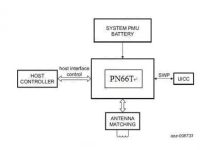
The PN66T and PN548C2 are fully compliant with the latest NFC specifications defined by the European Telecommunications Standards Institute (ETSI). They support the Single Wire Protocol (SWP) interface, which connects the NFC controller to the SIM card or embedded secure element, and they implement the Host Controller Interface (HCI) for efficient communication with the device’s application processor.
The PN66T is a system-in-package (SiP) solution that combines the PN548C2 NFC controller with NXP’s SmartMX2 P61 secure element. The PN66T hardware is pin-compatible with the PN548C2 in its BGA package variant, meaning device manufacturers can design a single PCB that supports both a standalone NFC controller and a full NFC+SE solution. This design flexibility reduces time-to-market and simplifies inventory management.
3.2 Security Features and Certifications
Security is the primary differentiator in NFC payment solutions. The PN66T integrates a security module that has achieved Common Criteria EAL6+ certification — the highest level of assurance awarded to a commercial mobile application processor. This certification provides a hardware root of trust for:
- Secure key storage and cryptographic operations (RSA, ECC, AES)
- Tamper detection and response mechanisms
- Secure boot and authenticated firmware updates
- Isolation of payment applets from the host operating system
Additionally, the PN66T has passed EMVCo certification, which is mandatory for interoperability with the global payment infrastructure. EMVCo certification ensures that the chip supports the full EMV contactless transaction protocol stack, including the cardholder verification methods (CVM) required for transactions above the contactless limit. For bank card issuers and smartphone OEMs, these certifications are non-negotiable requirements.
3.3 Technical Features of PN66T / PN548C2
- ARM Cortex-M0 microcontroller core for independent RF protocol processing
- NFC Forum-compliant NFC Controller Interface (NCI) for host communication
- Dual SWP interfaces supporting both SIM and embedded secure element
- Optional platform-independent software stack for OS integration (Android, Linux, RTOS)
- General-purpose I/O (GPIO) ports for controlling external peripherals
- Wide voltage supply range (typically 2.3V to 5.5V on appropriate pins)
- Security unit control interface for managing the companion SE
- Support for advanced RF protocols including ISO 18000-3, Kovio thin-film tags, and HID iClass tags
- Multiple RF interface protocol support: ISO 14443A/B, ISO 15693, MIFARE Classic/Plus/DESFire, and FeliCa
This breadth of RF protocol support is crucial for a unified payment and access solution. A single NFC controller can read MIFARE-based transit cards, interact with ISO 15693 library tags, and emulate an ISO 14443 payment card — all without additional hardware.
3.4 SmartMX2 P61N1M3 Secure Element Features
The security module embedded in the PN66T is the SmartMX2 P61N1M3, which offers:
- ARM SC000 secure processor core
- Non-volatile memory with 1 MB or higher capacity for multiple applets
- SPI interface to the host application processor
- JavaCard GlobalPlatform 2.2 operating system for flexible applet management
- Hardware support for MIFARE and DESFire emulation
- CC EAL6+ and EMVCo certification
- Multi-applet support for combining payment, transit, and loyalty applications
From an OEM perspective, the P61N1M3’s compliance with GlobalPlatform 2.2 is particularly significant. It allows secure over-the-air (OTA) provisioning of new applications after the device has shipped, meaning a smartphone launched in 2026 can add a new bank card applet or transit credential in 2028 without a hardware change.
4. NFC-SWP Software Architecture and Integration
The Single Wire Protocol (SWP) defines the physical layer and frame format for communication between the NFC controller and the SIM card or secure element. This architecture is the heart of the mobile payment approach favored by China Mobile and many global carriers. The NFC IC uses the SWP one-wire interface to exchange APDU (Application Protocol Data Unit) messages with the NFC-SIM card.
A well-structured NFC-SWP software stack is divided into several functional layers:
- Physical layer: The SWP electrical interface, operating at 1.2V or 1.8V logic levels, running at data rates up to 2.5 Mbit/s.
- Data link layer: SWP framing, error detection, and flow control.
- Transport layer: HCI (Host Controller Interface) routing of events, commands, and responses between the host CPU and the secure element.
- Application layer: The NFC Forum’s NCI (NFC Controller Interface) and the GlobalPlatform card specification for secure element access.
For terminal manufacturers, the standardization of this architecture means that the same baseband chipset can be paired with any certified NFC module and any compliant SIM card. This simplifies product certification and reduces integration risk.
5. Advantages and Limitations of NFC Payment
Advantages
Compared with traditional short-range communication payment methods such as infrared or Bluetooth, NFC payment offers clearly superior characteristics. The maximum operating distance is below 10 cm, which physically prevents accidental interference between nearby devices. Connection establishment and transaction execution complete in under 0.1 seconds — faster than a magnetic stripe swipe or a chip insertion. This speed combined with the short range delivers strong resistance to man-in-the-middle attacks and relay attacks, and it significantly lowers the total infrastructure cost for merchants, since existing contactless terminals can be leveraged.
Limitations and Deployment Concerns
The main barrier to widespread NFC payment adoption is not technical — it is ecosystem complexity. Universal adoption requires a sufficient installed base of NFC-enabled point-of-sale terminals, and deployment by phone manufacturers and financial institutions only makes sense once the addressable market is large enough. Table stakes, however, are not the only obstacle. The technology still faces critical questions that every deployment team must answer:
- Whose standard governs the secure element? Is the SE embedded in the phone hardware (eSE), hosted on the SIM card (SWP), or virtualized in the cloud (HCE)? Each option has trade-offs in security, carrier control, and user experience.
- What happens when a user’s phone is lost? Remote lock, remote wipe, and card suspension workflows must be in place and tested.
- How is the payment limit set? Different markets allow different thresholds for contactless transactions without PIN entry, and these limits affect user friction and fraud exposure.
These concerns are manageable, but they require infrastructure-level planning, not just chip-level design.
6. Real-World NFC Applications Across Industries
NFC technology has moved far beyond mobile payments. Because NFC chips are the same core technology used in many passive RFID tags, their applications extend throughout retail, logistics, manufacturing, and consumer engagement. The following sections outline the most commercially significant use cases today.
6.1 Retail and Smart Packaging
The retail industry was an early NFC adopter. Short-range tags are affixed to high-value cosmetics, luxury goods, electronics, and apparel, enabling consumers to tap their smartphones against a product to verify authenticity, access styling guides, and register warranties. For example, fashion brands embedding [RFID tags on clothes](https://www.dorfidtag.com/RFID-Tags-on-Clothes–Complete-Guide_2794.html) use NFC to bridge the physical-digital gap — a garment on a rack becomes an interactive channel that links to product-specific digital content.
For inventory management, the same tags support loss prevention and automated stock counting. UHF RFID remains the primary technology for case-level and pallet-level tracking, but NFC tags play a complementary role at the item level, especially in environments where consumer interaction is intended.
6.2 Logistics and Supply Chain
In logistics, NFC-enabled smart seals are deployed on security containers and tamper-evident packaging. A driver or inspector taps a handheld device — or even a smartphone — against the seal to record event time, location, and seal integrity. This enables a secure chain of custody without the need for expensive ruggedized readers at every checkpoint.
NFC also plays a role in asset maintenance. Service technicians can tap an NFC tag attached to a machine to retrieve its service history from the cloud, log their visit, and update the maintenance record. In manufacturing environments, NFC tags embedded in tooling and fixtures provide a reliable, non-line-of-sight method for tracking maintenance intervals and calibration data.
6.3 Manufacturing and Industrial Automation
NFC’s short read range is an advantage in manufacturing settings because it prevents unintended reads from nearby machines or operators. An NFC tag attached to a work-in-progress (WIP) carrier can store its route card in the tag’s memory, or simply carry a unique ID that references a central production database. Tools with embedded NFC tags can be paired with a specific machine station, ensuring that the correct tool is used for each job.
The NFC Forum’s Tag Type 2 and Type 5 specifications are particularly relevant in industrial settings due to their low cost and compatibility with MIFARE and ISO 15693 readers. These tags are available in robust, embeddable form factors engineered for harsh environments.
6.4 Smart Media and Marketing
NFC smart posters embed a passive NFC tag encoded with a URL, a phone number, or a Wi-Fi provisioning string. A consumer tap triggers the appropriate action with zero friction. In museums, NFC tags placed beside exhibits deliver rich audio guides to visitors’ headphones through their personal smartphones. At transit stops, NFC-enabled schedules update users to real-time arrival information.
6.5 Electronic Ticketing and Access Control
Electronic tickets are among the most established NFC applications. Event venues, theme parks, and public transit systems issue credentials as NFC cards or mobile passes. Consumers purchase access rights online, provision them to their NFC device, and tap to enter.
Beyond ticketing, NFC is foundational to modern building access. NFC credential cards and mobile keys are replacing Wiegand-based proximity cards in offices and hotels. Since NFC supports mutual authentication, forged cards are far more difficult to create than with legacy low-frequency technology.
7. Choosing the Right NFC Tags and Readers
From an engineering perspective, selecting the right NFC components is a multi-dimensional decision. As a manufacturer, we evaluate the following factors with every customer.
7.1 Tag IC Selection
The NFC tag IC determines memory size, read/write speed, security features, and cost. The most common NFC tag ICs include:
- NXP NTAG213: 144 bytes of user memory, ideal for URL encoding, simple product authentication, and short payloads.
- NXP NTAG215: 504 bytes of user memory, suitable for larger data payloads, vCard storage, and gaming applications. The choice between these two ICs is a frequent engineering question — we provide a detailed [comparison of NTAG215 versus NTAG213](https://www.dorfidtag.com/NTAG215-vs-NTAG213-Choosing-the-Right-NFC-Tag-for-Your-Project_2820.html) to help teams make this decision.
- NXP NTAG216: 888 bytes of user memory, ideal for ownership vouchers and multi-URL configurations.
- NXP MIFARE Ultralight / DESFire: For applications requiring security features such as mutual authentication and encrypted data transfer, MIFARE DESFire EV2/EV3 is the de-facto standard in transit and access control.
Each IC family has its own RF sensitivity, Q-factor requirements, and memory organization, all of which influence the antenna design of the finished [custom RFID sticker](https://www.dorfidtag.com/Custom-RFID-Stickers_2575.html) or inlay.
7.2 Antenna and Form Factor Design
The antenna is the most critical element in NFC tag performance. A standard NFC inlay uses a multi-turn coil printed or etched on a PET substrate. The coil inductance (typically 2.0–3.0 μH), the number of turns, the trace width, and the connection to the IC all determine the read range and reliability. When designing custom tags for specific products, we consider:
- The dielectric properties of the host material (metal, plastic, wood, glass, liquid).
- The available footprint on the product or packaging.
- The expected read distance (usually 5–30 mm for NFC).
- The operating temperature range.
- The installation method (adhesive, heat transfer, in-mould, embedment).
For metallic products, a ferrite sheet or an air-gap antenna design is mandatory to detune the tag from the metal surface. Ignoring this step leads to severely degraded read performance.
7.3 Reader and Infrastructure Selection
When a business moves beyond smartphone-based reading and deploys fixed stations — for time and attendance, product kiosks, or automatic hand sanitizer dispensers — selecting a reliable reader module is essential. Industrial NFC readers typically support ISO 14443A/B and ISO 15693 simultaneously, and they communicate with a host PC or PLC via USB, RS-232, or TCP/IP. For custom projects, an evaluation kit from a reputable [RFID reader manufacturer](https://www.dorfidreader.com/) shortens the development cycle considerably. Full-size enterprise deployments, such as airport bag tagging or warehouse kiosks, depend on readers built for 24/7 continuous operation.
8. Deployment Considerations for NFC Solutions
Deploying an NFC solution requires more than buying tags and readers. Hardware is only a fraction of the total effort. The following checklist is derived from our experience delivering RFID solutions across retail, logistics, and smart-building verticals.
8.1 Physical Environment
Evaluate environmental factors including temperature extremes, humidity, exposure to chemicals or UV light, and mechanical abrasion. NFC tags installed on outdoor assets or in direct sunlight should be encapsulated in durable housings with UV-stabilized materials. For laundry and textile uses, NFC tags must withstand repeated washing, drying, and ironing. Our [RFID tags on clothes](https://www.dorfidtag.com/RFID-Tags-on-Clothes–Complete-Guide_2794.html) guide covers the specific material recommendations for textile integration.
8.2 Data Architecture and Integration
Decide whether the NFC tag will store application data directly, or whether it will only store a unique identifier that links to a backend database. In payment, the secure element stores the payment credentials. In logistics, the tag often stores a unique shipment ID, while the entire shipment history remains in the cloud. Both approaches are valid — the choice depends on connectivity availability, offline requirements, and data privacy policies.
8.3 Testing and Certification
NFC devices must pass electromagnetic compatibility (EMC) testing and regulatory certification (FCC, CE, etc.) in every target market. In addition, NFC-enabled payment products must achieve EMVCo and GlobalPlatform certification. Tag-only deployments (non-payment) require fewer certifications, but they must still comply with local radio frequency regulations for the 13.56 MHz band. Prototype-level testing must also validate read range, write reliability, and tag-to-reader interoperability across a range of devices.
We provide engineering samples to qualified teams performing these tests. The [RFID reader portfolio](https://www.dorfidreader.com/portfolio-types/rfid-readers/) at Dorfid includes evaluation tools and OEM modules suitable for early-stage prototyping.
9. Industry Outlook: The Future of NFC
NFC’s future is closely tied to the digitization of identity and value transfer. As mobile wallets and digital IDs mature, the “tap anywhere” experience is becoming an expected baseline in Western Europe and Asia. Several trends will shape the next five years:
- NFC and 5G convergence: With 5G, NFC’s short-range tap is combined with cloud-based identity checks and high-speed back-end verification for semi-autonomous transactions.
- NFC-enabled IoT provisioning: The “tap to configure” model is becoming standard for smart home devices. An NFC tag hidden inside a Wi-Fi router or smart speaker simplifies onboarding to seconds.
- Post-quantum cryptography: As quantum computing advances, the migration of secure elements to support post-quantum algorithms will be a long-term security consideration. The EAL6+ certified hardware root of trust will play a role in this transition.
- Paper-thin NFC batteries: Battery-assisted NFC tags with printed batteries will allow sensors to log temperature readings and deliver them to any NFC reader without a wired connection.
Each of these trends reinforces the relevance of NFC technology in the IoT ecosystem. As long as the interaction is human-initiated, short-range, and security-sensitive, NFC is the optimal communications channel.
10. Frequently Asked Questions (FAQ)
What is the difference between NFC and Bluetooth for proximity applications?
NFC operates at 13.56 MHz with a read range under 10 cm, establishing a connection in under 0.1 seconds. Bluetooth operates at 2.4 GHz with a range of 10–100 m and requires a pairing procedure. NFC’s shorter range and faster connection make it better suited for secure transactions, where physical proximity is a proxy for user intent. Bluetooth remains better suited for high-bandwidth data streaming over longer distances.
Can NFC tags be read by standard smartphones?
Yes. All modern smartphones (iOS and Android) include an NFC controller that supports reader/writer mode, peer-to-peer mode, and card emulation. On iOS, the system automatically reads NFC tags when the device is unlocked by default, though some third-party apps use the Core NFC framework for custom tag reading.
What memory size do I need for an NFC tag?
For a basic URL or NDEF text record, an NTAG213 (144 bytes) is sufficient. For larger payloads — such as a vCard with a photo, JSON metadata, or multiple records — an NTAG215 (504 bytes) or NTAG216 (888 bytes) is recommended. If you require cryptographic security and encrypted data storage, a MIFARE DESFire tag is the appropriate choice.
How do I choose between NTAG213 and NTAG215?
The decision depends primarily on the payload size and read reliability requirements. The NTAG215 has higher memory and slightly stronger RF performance, while NTAG213 is more cost-effective. Our engineering team has published a detailed [NTAG215 vs NTAG213 comparison](https://www.dorfidtag.com/NTAG215-vs-NTAG213-Choosing-the-Right-NFC-Tag-for-Your-Project_2820.html) to guide your selection.
Can NFC tags work on metal surfaces?
Only with a properly designed antenna. A standard NFC tag mounted directly on metal will detune and become unreadable. You must either use a tag with an integrated ferrite absorber layer or design an air-gap antenna. We offer on-metal NFC tags specifically engineered for metallic asset tracking.
Is NFC secure enough for access control?
Yes. NFC access control systems use mutual authentication and encrypted communication between the credential and the reader. MIFARE DESFire EV2/EV3, in particular, supports AES-128 encryption and a secure channel that protects against replay and relay attacks. This is the same technology used by most transit systems worldwide.
Conclusion
NFC technology has matured from a payment-only enabler into a versatile connectivity standard with applications spanning retail, logistics, manufacturing, and smart infrastructure. From a manufacturer’s perspective, the key to successful NFC deployment lies in understanding the interplay between tag IC selection, antenna design, reader infrastructure, and backend software. The standards ecosystem — ISO 14443, ISO 15693, MIFARE, and the NFC Forum specifications — is mature and stable, providing a solid foundation for long-term product development.
For businesses that are planning an NFC deployment, the fastest path to reliable results is to start with proven components and engineering support. Partnering with an experienced [RFID reader manufacturer](https://www.dorfidreader.com/) and a custom tag supplier like Dorfid ensures that your project begins with validated hardware rather than trial-and-error prototyping.
Dorfid is a manufacturer of RFID and NFC tags, inlays, and readers. We provide design engineering support, custom antenna development, and high-volume production for NFC-based solutions across multiple industries. Contact our engineering team to discuss your specific requirements.
“`