
 chrispeng
 “`html
RFID Truck Scale Weighing Management: Engineering a Fully Unattended Weighbridge System
Across urban infrastructure development, coal mining, cement production, petrochemical processing, grain storage, feed manufacturing, metallurgy, and the broader chemical industry, electronic weighing is no longer a peripheral support function—it is the operational backbone of logistics and inventory control. Yet traditional weighbridge operations remain plagued by a fundamental paradox: the weighing room is typically located far from the management office, making direct supervision impractical. Heavy reliance on manual data entry and paper-based calculation introduces human error, creates bottlenecks during peak traffic, and opens the door to fraud. As production capacity expands and the volume of inbound and outbound goods increases, these weaknesses become operationally critical.
RFID technology, when properly integrated into truck scale weighing systems, resolves these problems through long-range automatic identification, unattended operation, and real-time data integration. This article—written from the perspective of an RFID manufacturer and system integrator—explains how a fully automatic intelligent weighing system works, how it should be specified, and what you must consider when deploying one.
The Case for RFID-Enabled Weighbridge Automation
A weighbridge, also known as a truck scale, is a high-value asset that typically operates 24/7. Under a conventional manual process, a weighmaster must visually identify the truck, record the license plate, wait for the weight reading to stabilise, key the figure into a management system (or even a paper log), and then issue a receipt. Multiply this by hundreds of trucks per day, and the inefficiencies become obvious: queues form, the weighbridge is underutilised, and each manual step is a source of potential error or deliberate manipulation.
RFID technology eliminates these pain points. By attaching an RFID tag—usually a UHF RFID sticker or vehicle tag—to each transport vehicle, the system can automatically identify the truck as it approaches the weighbridge, without requiring the driver to stop, roll down a window, or present a card. This creates the foundation for a genuinely unattended weighing workflow. The combination of RFID with automatic number plate recognition (ANPR), infrared anti-cheating sensors, traffic lights, and barrier gates produces a system that can run round-the-clock with minimal human intervention.
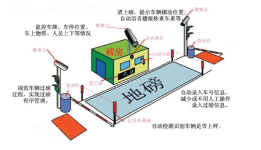
System Architecture: Core Components of a Smart Weighbridge
From a manufacturer’s design standpoint, an RFID-based intelligent truck scale weighing system is not a single device but an integrated assembly of hardware and software. The following components are essential:
1. UHF RFID Reader and Antenna System
The reader is the heart of the identification process. In modern weighbridge deployments, passive UHF RFID products operating in the 900–960 MHz band are the mainstream choice. The antenna, positioned strategically beside or above the weighbridge platform, interrogates the tag on the truck as it enters the weighing zone. Because passive tags draw power from the reader’s RF field, no battery is needed on the vehicle, which minimises maintenance cost and improves reliability in dusty or harsh environments.
2. Attached RFID Vehicle Tags
The tag itself must be selected for durability and read consistency. For vehicle applications, a vehicle RFID sticker with strong weather resistance and anti-metal properties is recommended. The tag carries a unique ID linked in the database to the vehicle’s license plate, driver name, and cargo type, so that any read is immediately converted into actionable information.
3. Automatic Vehicle Number Recognition (ANPR)
ANPR cameras capture the license plate at both inbound and outbound points. The system then cross-checks the plate against the RFID-tag-driven database, ensuring that the physical vehicle matches its electronic identity. This dual-verification is the industry standard for anti-fraud protection in unattended weighing.
4. Automatic Voice Command System
A voice module guides the driver through the weighing process, instructing them to move forward, stop, or wait. This is particularly valuable in countries or regions with low literacy rates or in environments where the weighbridge is operated by a single remote supervisor.
5. Weighing Image Instant Capture
High-resolution cameras photograph the vehicle at the moment the gross weight or tare weight is recorded. This image is stored together with the RFID read, the weight data, and the timestamp, creating a tamper-proof evidentiary record that can be reviewed from the management office at any time.
6. Infrared Anti-Cheating System and Traffic Control
Infrared beams detect whether a truck is fully on the platform or attempting to park partially off-scale. Combined with traffic lights and automatic barrier gates, the system enforces correct positioning before a weight is accepted. This eliminates the classic “one wheel off the scale” fraud and the double-weighing trick.
7. Remote Monitoring and Management Software
The software middleware bridges the weighing hardware and the enterprise’s third-party management systems, such as ERP or automatic material deduction systems. The software layer is responsible for data acquisition, stability judgement, image triggering, receipt printing, and communication with the central database. Modern designs adopt a modular architecture so that each subsystem can be upgraded independently.
How the Automated Weighing Workflow Operates
To understand why RFID delivers measurable gains, it is useful to walk through the actual measurement and transportation procedure. The following sequence is typical of a well-engineered unattended weighbridge installation:
Step 1—Factory Entry: The empty truck enters the industrial zone. An RFID antenna installed at the gate reads the vehicle tag; the system verifies that the vehicle is authorised, opens the barrier, and log the time of entry.
Step 2—Tare Weighing: The empty truck approaches the weighbridge. In this area, an RFID antenna, a barrier gate, and an ANPR camera operate together. The system records the license plate, the empty vehicle weight, and rewrites the tag’s data field to update an identification bit that marks that tare weighing has been completed. The driver is given a clear instruction via the voice system to proceed to the loading zone.
Step 3—Loading: At the loading area, another RFID antenna records the time of arrival and the specific product information that has been assigned to the vehicle. This ensures traceability from the moment the cargo is loaded to the moment of final weighing.
Step 4—Weighbridge Queue Control: After loading, the truck returns to the weighbridge. A barrier gate at the entrance opens only when the previous vehicle has been cleared and the loaded truck is correctly positioned on the weighing platform. This prevents queuing across the load cells and avoids the awkward situation where two vehicles are on the scale simultaneously.
Step 5—Gross Weighing and Release: The exit-side RFID antenna and ANPR camera perform a second identity check. The system compares the license plate data with the tag ID, then computes the net weight by subtracting the stored tare value from the measured gross weight. The weighing software sends the final result to the enterprise management system, updates the identification bit, prints the receipt, and opens the exit barrier.
Step 6—Factory Exit: The loaded truck reaches the final gate. An RFID reader confirms that the vehicle has completed the full cycle (tare, load, gross, and payment if required) and authorises departure.
By implementing this sequence, a truck scale can process a vehicle in under two minutes, compared to five to ten minutes for a manual operation. For a large logistics hub handling 500 inbound and outbound vehicles per day, this can reduce queueing time by a factor of three.
Technical Design Standards for Industrial-Grade RFID Weighbridge Systems
An RFID weighing system is only as good as its mechanical and electronic design. In 24/7 industrial operation, three categories of design criteria are non-negotiable.
High Reliability Design
Every subsystem—from the RFID reader to the weighbridge controller—must be designed for continuous operation without scheduled downtime. This is achieved through thorough electromagnetic interference (EMI) protection and electrostatic discharge (ESD) shielding, both of which are common sources of false reads and system resets in heavy industrial environments. The hardware should use isolated DC/DC power converters to improve noise immunity, and all data communication between modules should follow international standards such as MODBUS, TCP/IP, or RS-485, with rigorous error-checking and retry logic. A modular architecture ensures that a failed antenna or reader can be swapped out in minutes without reconfiguring the entire network.
Environmental Adaptability
Weighbridge equipment operates outdoors, exposed to rain, dust, temperature extremes, and occasional vibration from heavy trucks. Industrial-grade components are mandatory, not optional. The product’s structural housing must be both strong and corrosion-resistant, with a service life target of at least five years. The enclosure should provide IP65 protection where applicable, and the internal electronics must be sealed against moisture ingress. For installations in regions with frequent thunderstorms, the system must support Class-3 lightning protection and be capable of defending against induced surges, which are the leading cause of equipment damage in exposed yard environments.
Data Security and Auditability
If the weighing management system is to be trusted for settlement and tax purposes, the data files must be protected. Role-based access control ensures that creation, modification, deletion, and querying of data require appropriate authorisation. Additionally, all modifications or deletions of original weighing records should be written to an immutable log file. This audit trail is essential both for detecting internal fraud and for complying with regulatory and financial audit requirements. When the system is connected to an ERP or accounting suite, the middleware must use encrypted communication and verify the integrity of each transmitted record.
Deployment Considerations: What You Must Know Before Installation
RFID technology is not a plug-and-play purchase. A successful deployment depends on careful advance planning in the following areas:
Antenna Positioning and Read Zone
The read zone must align with the vehicle’s stopping position on the weighbridge. A tag mounted on a truck’s windshield or on a metal bracket behaves differently from a tag on a plastic bumper—the RF reflection off the metal cab can create null zones where reads fail. In practice, we recommend that a site survey be conducted with the actual truck fleet to determine the optimum antenna mounting height and angle. The use of a circularly polarised antenna is strongly advised for truck applications because it can read tags in any orientation, whereas a linearly polarised antenna requires the tag to be aligned with the reader’s polarisation.
Tag Selection for Harsh Environments
The tag you mount on a truck must endure UV exposure, rain, vibration, and frequent washing. UHF tags intended for vehicle windshield mounting must have an adhesive that will not degrade under thermal cycling. If you prefer a screw-mounted tag for permanent attachment to a metal surface, you will need an on-metal UHF tag. If external approach is needed, the vehicle tag portfolio available from our engineering team covers both windshield and metal-mount variants. Do not use a general-purpose retail tag for a weighbridge project—it will fail within months, if not weeks.
Integration with Existing ERP Infrastructure
The weighing system does not exist in isolation. It must exchange data with the enterprise’s existing management packages, including ERP, automatic material deduction, and logistics dispatch systems. The software middleware should therefore support a range of legacy and modern protocols. Start the integration conversation early—ideally before the hardware is even ordered—to ensure that the data fields such as tare weight, gross weight, net weight, time, and vehicle number format are agreed upon by all parties.
Driver Training and Change Management
The final operational concern is human. Truck drivers who are accustomed to stopping at a weighbridge office for a paper ticket must be trained to follow the automatic voice instructions. The installation of a metering and transportation vehicle dispatch centre, where every driver is issued an RFID card or vehicle tag encoded with their vehicle and route information, is a necessary preparation step. Without this, even the most advanced RFID antenna will be useless, because the system will not have the fundamental data to identify a vehicle.
Real-World Industrial Applications
The unattended RFID weighbridge system is not theoretical. It is already working successfully in a broad range of industrial settings, including:
- Power plants—managing the continuous inbound supply of coal or biomass feedstocks, where a single plant may receive more than two hundred trucks per day.
- Mines and quarries—where dust, mud, and vibration would destroy less robust barcode or camera-only identification systems, but where UHF RFID excels.
- Municipal waste transfer stations—time-stamping inbound and outbound loads to enforce tipping fees and manage fleet product.
- Cement and aggregate plants—measuring the net weight of delivery vehicles in high-volume dispatch environments.
- Construction and muck disposal sites—controlling and weighing dump trucks that operate between construction sites and regulated disposal facilities.
- Recycling facilities—where accurate net weight is essential for paying suppliers and validating collection efficiency.
In every one of these applications, the core business objective is identical: improve the accuracy and timeliness of data capture, reduce the cost and error rate of manual operations, and deliver the productivity data to management in a digestible, real-time format. RFID accomplishes this far more effectively than barcoding because it requires no line-of-sight, supports detection distances of more than six metres, and remains readable under the dirt and grime that defeats optical technologies.
Choosing the Right RFID Manufacturer: Selection Guidance
When evaluating RFID suppliers for a truck scale weighing project, consider the following selection criteria:
Vertical Integration and Customisation
Numerous RFID sticker suppliers sell generic tags, but few understand the wiring and logic of a weighbridge system. Choose a manufacturer or integrator that can supply the reader, the antenna, the tag, and the middleware as a unified system, and which is prepared to adapt the product design to your particular vehicle fleet and scale layout. At our manufacturing facility in Xiamen, we regularly produce custom-sized UHF tags and tailored mounting kits for weighbridge installations.
Testing and Quality Control
Ask about the manufacturer’s testing protocols. A serious supplier will test each tag for read sensitivity and environmental resilience across the full working temperature range before shipping. For high-value weighbridge contracts, demand a site pilot test in which the proposed tag and reader are trialled on real trucks in your own yard. This will reveal read-rate weaknesses that cannot be discovered in a clean laboratory.
Lifecycle Support
The weighbridge system is expected to run for years. Does the manufacturer provide firmware updates for their readers? Can they advise on spare parts availability? What is their policy on obsolete tag types? A supplier with a clear product roadmap will ensure that your investment is not stranded if a government regulation on radio emissions changes or a new tag frequency band is mandated.
Frequently Asked Questions
Can RFID weighing systems work with all types of truck scales?
Yes. RFID identification is independent of the weighing mechanism itself. The system can be retrofitted onto both analogue and digital weighbridges, as well as into in-motion rail scales, provided the interface allows the weighing controller to communicate with the management software. Most modern load cell indicators have RS-232 or RS-485 ports, which can be connected to the RFID middleware.
What is the read distance of the RFID reader?
For passive UHF devices operating in the 900–960 MHz band, read distances of 6 to 12 metres are achievable depending on the tag type and the reader output power. In a weighbridge design, we typically recommend 4–6 metres effective read range, sufficient to read the tag while the truck is stopped on the platform, without reading the tag of a vehicle waiting behind it. Beam shaping via antenna placement is used to avoid cross-reads.
Will RFID tags be damaged by weather or washing?
An industrial-grade tag with an IP68-rated housing will withstand rain, ice, salt, pressure-washing, and prolonged exposure to moisture. The adhesive used for mounting must match the surface material and the expected temperature range. Freezer or extreme desert heat require specially rated adhesives, which can be supplied upon request.
Can the system handle both inbound and outbound reading with a single reader?
Technically, a single reader with a switchable antenna array can cover both approaches. However, operational reliability improves when you use two separate readers: one for inbound identification, one for the weighbridge platform. This avoids antenna switching delays and eliminates the risk of misrouting the data. The increased hardware cost is justified by higher throughput.
How do we prevent a driver from swapping tags between trucks?
This is solved by binding the tag ID to the license plate during the vehicle registration process and cross-validating it with the ANPR camera at both entry and weighing points. If the tag ID does not match the plate, the system creates an alarm and the vehicle is refused. The immutable association of those two data points is the central anti-fraud principle of the system.
Is a server and a network connection mandatory for operation?
For true unattended operation, yes. The automation depends on a central database that stores vehicle weights and historical records. However, for smaller sites with a single scale, the system can be configured to run on a standalone PC with a local database, synchronising with the office server later via network or manual export. We recommend that even the smallest deployment install a UPS power supply to protect the computer and network equipment from power outages.
The Bottom Line: From Manual Weighbridge to Intelligent Infrastructure
RFID-based truck scale weighing is now the standard answer for companies that want to reduce weighbridge process costs and improve data reliability. The technology enables gross weight, tare weight, net weight, photos, and timestamps to be automatically collated for every vehicle, eliminating manual entry errors and the opportunity for theft in the dispatch process. For a management department, the immediate result is the ability to monitor production and logistics status in real time through a summary report; for the financial settlement department, an accurate and auditable basis for supplier and customer transactions; and for the warehouse department, a trustworthy record of goods received and dispatched. This information integration shortens decision response time, improves overall management efficiency, reduces warehousing and transport operating costs, and accelerates the digital transformation of the enterprise.
If you are planning a weighbridge automation project, the prudent first step is not purchasing hardware—it is defining your vehicle flow, data integration points, and anti-fraud requirements with a qualified vehicle RFID system partner. The correct engineering choices, supported by a robust UHF tag supply chain, will yield a system that operates dependably for a decade or more.
The future will bring even tighter integration between RFID weighbridges and artificial intelligence-based analytics. Weight data streams will feed predictive algorithms that identify anomalies in vehicle load patterns, provide maintenance warnings for trucks, and enable dynamic route optimisation for fleets. Companies that invest in RFID-enabled weighing management today are positioning themselves to capture those advanced efficiencies tomorrow.
“`