
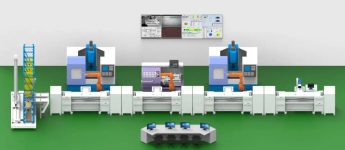
Industrial intelligent manufacturing production line applies RFID technology to realize production visualization management
 chrispeng
 “`html
RFID Technology in Industrial Intelligent Manufacturing: Achieving Production Visualization and Control
As global manufacturing moves toward deeper automation and data-driven decision-making, the need for real-time, accurate, and non-contact identification across production lines has never been greater. Traditional barcode systems, while still in use, fall short in harsh industrial environments where dust, moisture, vibration, and high-speed movement are common. Radio Frequency Identification (RFID) technology has emerged as a core enabler of industrial intelligence, providing the perception layer capabilities required for true production visualization and control. This article explores how industrial intelligent manufacturing production lines apply RFID technology to realize production visualization management, offering technical insights, deployment guidance, and product selection advice from a manufacturer’s perspective.
The Role of RFID in Smart Manufacturing Production Lines
From Automation to Intelligence: The Evolution of Production Tracking
Industrial manufacturing environments are inherently complex. Production lines involve multiple stations, diverse materials, work-in-progress (WIP) items, tooling, and equipment that must be coordinated precisely. RFID technology, through the use of RFID tags and readers, enables the automatic identification and collection of data without line-of-sight requirements. Unlike barcodes, RFID can read multiple tags simultaneously, penetrate non-metallic materials, and operate reliably in extreme temperatures, dust, and humidity. This makes RFID the ideal choice for manufacturers seeking to build a transparent, real-time production environment.
Key Technical Capabilities of RFID in Harsh Industrial Environments
RFID technology supports read/write operations wirelessly and remotely. RFID readers can communicate with tags at distances ranging from a few centimeters to over ten meters, depending on frequency and power. The ability to read tags in motion — even at high conveyor speeds — ensures that production data is captured without slowing down operations. Furthermore, RFID electronic tags can store significantly more data than barcodes, including product specifications, batch numbers, timestamps, process histories, and quality check results. This data density is critical for traceability and compliance in industries such as automotive, electronics, and food production.
Core System Architecture and Data Flow
RFID Tag Attachment and Data Encoding
In a typical intelligent manufacturing production line, RFID tags are attached either directly to the product or to the pallet, tray, or fixture carrying the product. Each tag carries a unique identifier (UID) and can be written with production-related information such as product model, quantity, responsible operator, and scheduled routing. Before production begins, the tag ID is bound to the production batch number using the management system. This binding is typically performed by reading the tag ID via an RFID reader while scanning the production barcode with a barcode scanner. This hybrid approach ensures backward compatibility while transitioning to full RFID-based tracking.
Reader Deployment and Data Acquisition
Fixed RFID readers are installed at key process points along the production line — such as entry and exit of stations, quality inspection gates, and material transfer points. When a tagged product passes through the read zone, the reader captures the tag data and transmits it to the host system via industrial network protocols (e.g., Modbus TCP, OPC-UA, or MQTT). This enables real-time visibility of product location, station completion status, and cycle time. As shown in the system flow, when a product sequentially passes RFID Reader A and RFID Reader B, the system compares the read data to determine if all required processes have been completed and whether the product should proceed to the next station or be flagged for rework.
Real-Time Data Transmission to Host Systems
Each collection point on the production line is equipped with read/write devices that automatically capture tag information and push it to the backend. Production managers can access a centralized dashboard showing real-time material flows, station utilization, and bottleneck analysis. This data foundation supports advanced applications such as digital twin simulation, predictive maintenance, and dynamic production scheduling.
Production Line Process Management with RFID
Process Point Control and Work-in-Progress Tracking
RFID enables granular control at each process point. For example, at a welding station, the RFID system can verify that the correct component is present before allowing the welding robot to operate. If the wrong part is detected, the system can automatically halt the line and alert the operator. Similarly, at assembly stations, RFID ensures that all sub-components are present and correctly matched before final assembly proceeds. This reduces defects and rework costs significantly.
Binding RFID Tag IDs to Production Batches
The production management system binds each RFID tag to a specific production batch at the start of the line. As the product moves through each station, the reader writes process completion data into the tag memory. This includes station ID, timestamp, operator ID, and quality inspection results. The result is a complete, tamper-proof digital record of every product’s journey through the factory floor.
Automated Process Verification and Rework Prevention
When a product reaches the final station, the RFID reader performs a comprehensive check. If any process step is missing or incomplete, the system automatically routes the product to the appropriate rework station. This eliminates reliance on manual inspection and significantly reduces the risk of defective products reaching customers. After successful completion, the system unbinds the RFID tag from the production barcode and stores the production barcode as the permanent unique identifier for future traceability.
Practical Applications and Benefits
Data Collection and Material Flow Control
Attaching RFID tags to materials and pallets allows the system to record specifications, quantities, timestamps, and responsible personnel automatically. This eliminates manual data entry errors and provides managers with accurate, real-time visibility into material availability and consumption. Production schedules can be adjusted dynamically based on actual material flow, reducing work-in-progress inventory and improving line efficiency.
Production Status Monitoring and Schedule Adjustment
RFID readers installed at strategic points feed real-time status data to the production management system. Managers can see exactly which products are at which stations, how long they have been there, and whether any station is falling behind schedule. This visibility enables proactive decision-making — for example, reallocating labor or resources to bottleneck stations before they impact overall throughput.
Finished Product Traceability and Quality Assurance
For finished products, the complete production history is stored in the database, linked to the unique production barcode. In the event of a quality issue, manufacturers can trace the product back to the specific batch, station, and operator involved. This capability is increasingly required by regulatory bodies in industries such as automotive, medical devices, and food and beverage. RFID also supports the growing demand for RFID tags on clothes and other consumer goods, enabling brand protection and supply chain visibility beyond the factory floor.
Deployment Considerations for RFID in Manufacturing
Environmental Factors and Tag Selection
Industrial environments present unique challenges for RFID deployment. Metal surfaces, liquids, extreme temperatures, and electromagnetic interference can all affect read performance. For metal-intensive applications, specialized on-metal RFID tags are required. For high-temperature processes (e.g., paint curing or welding), heat-resistant tags with ceramic or PPS housings are available. When choosing between NFC and UHF RFID, understanding the use case is critical. For example, understanding NTAG213 vs NTAG215 differences helps select the right NFC tag for short-range, item-level applications, while UHF RFID is better suited for long-range, high-speed production line tracking.
Reader Placement and Antenna Configuration
Proper reader and antenna placement is essential for reliable tag read rates. In conveyor applications, antennas should be positioned to create a consistent read zone that covers the entire tag population as it moves through. Circularly polarized antennas are preferred when tag orientation is unpredictable. For portal or gateway applications, multiple antennas may be needed to eliminate blind spots. Site surveys and read-rate testing should be conducted before full deployment.
Integration with Existing PLC and MES Systems
RFID systems must integrate seamlessly with existing Programmable Logic Controllers (PLCs), Manufacturing Execution Systems (MES), and Enterprise Resource Planning (ERP) platforms. Most industrial RFID readers support standard industrial protocols such as Modbus, Profinet, and EtherNet/IP. Middleware software is often used to filter, aggregate, and forward tag data to upstream systems. Choosing an RFID reader manufacturer with strong integration support and a proven SDK can significantly reduce deployment time and risk.
Product Selection Guidance
Choosing the Right RFID Tag for Industrial Use
Selecting the correct RFID tag depends on the material of the item being tagged, the required read range, and the environmental conditions. For plastic pallets and non-metal containers, standard UHF RFID stickers offer a cost-effective solution. For metal tools and equipment, on-metal tags with ferrite shielding are necessary. For high-temperature applications, ceramic tags capable of withstanding 200°C or more are available. Memory size is another consideration — some applications require only a unique ID, while others need writable memory for process data.
Selecting RFID Readers and Antennas
Fixed RFID readers are ideal for conveyor portals, station gates, and automated inspection points. Handheld readers are useful for manual data collection, inventory checks, and maintenance operations. When selecting a reader, consider output power (which affects read range), protocol support (EPC Gen2 v2 is recommended for advanced features), and network connectivity. Antenna selection should consider gain, polarization, and beam width to match the physical layout of the read zone.
Handheld vs. Fixed Readers for Different Use Cases
Fixed readers provide automated, unattended operation and are best suited for high-volume, continuous production environments. Handheld readers offer mobility and flexibility for tasks such as quality audits, tool tracking, and warehouse verification. In many manufacturing facilities, a combination of both is used — fixed readers for production line automation and handheld readers for peripheral processes.
Industry Insights and Future Trends
RFID in Automotive Manufacturing
Automotive manufacturers were early adopters of RFID for production tracking. Today, RFID is used to track engines, transmissions, and body panels through assembly lines, ensuring that the correct parts are installed at each station. The ability to store process data directly on the tag enables just-in-time delivery and reduces inventory buffers. As electric vehicle production scales, RFID is also being used to track battery cells and modules through the manufacturing process.
RFID in Electronics Assembly
In electronics manufacturing, RFID enables precise tracking of printed circuit boards (PCBs) through soldering, inspection, and testing. The compact size of UHF RFID tags allows them to be embedded in PCB carriers or even directly on small components. Real-time tracking helps identify yield issues early and supports component-level traceability for compliance with regulations such as RoHS and REACH.
RFID in Food and Beverage Production
The food and beverage industry requires strict traceability to ensure food safety and regulatory compliance. RFID tags on pallets, crates, and individual packages enable end-to-end tracking from raw material to finished product. Washable, chemical-resistant tags are available for environments that require frequent sanitation. Combined with temperature and humidity sensors, RFID can also monitor cold chain compliance throughout production and distribution.
Frequently Asked Questions (FAQ)
1. What is the difference between RFID and barcode in manufacturing?
RFID does not require line-of-sight to read tags, can read multiple tags simultaneously, and can store more data than barcodes. RFID tags are also more durable in harsh industrial environments and can be read at high speeds while items are in motion. Barcodes are cheaper per label but require manual scanning and are prone to damage.
2. Can RFID work on metal surfaces and in high-temperature environments?
Yes. Specialized on-metal RFID tags use ferrite shielding or cavity designs to function reliably on metal. For high-temperature applications (up to 200°C or more), ceramic or PPS-housed tags are available. It is important to select the correct tag for your specific environmental conditions.
3. How does RFID improve production line efficiency?
RFID automates data collection, reduces manual entry errors, provides real-time visibility of work-in-progress, enables automatic process verification, and helps identify bottlenecks. These capabilities reduce cycle times, minimize rework, and improve overall equipment effectiveness (OEE).
4. What is the typical read range for UHF RFID in industrial settings?
For passive UHF RFID (860-960 MHz), read ranges typically vary from 3 to 10 meters depending on tag type, reader power, and environmental conditions. For high-speed conveyor applications, read ranges of 1 to 3 meters are common to ensure reliable reads within a controlled zone.
5. How do I integrate RFID with my existing PLC or MES system?
Most industrial RFID readers support standard communication protocols such as Modbus TCP, Profinet, EtherNet/IP, and OPC-UA. Middleware software can be used to convert RFID data into formats compatible with your existing systems. Many manufacturers also provide SDKs and API documentation for custom integration.
6. What is the lifespan of an RFID tag in an industrial environment?
Passive UHF RFID tags have no internal battery and can last indefinitely under normal conditions. However, physical wear, chemical exposure, and extreme temperatures can degrade performance over time. Most industrial tags are rated for millions of read/write cycles and can last for years in typical manufacturing environments.
7. Can RFID help with regulatory compliance and traceability?
Yes. RFID provides a complete, tamper-proof digital record of every product’s production history, including materials, processes, operators, and timestamps. This data supports compliance with regulations such as ISO 9001, IATF 16949, FDA 21 CFR Part 11, and EU food traceability directives.
8. What should I consider when choosing between HF and UHF RFID for my production line?
HF RFID (13.56 MHz) offers better performance near metal and liquids and is commonly used for item-level tracking in pharmaceuticals and medical devices. UHF RFID offers longer read range and higher read rates, making it ideal for high-speed production lines and supply chain applications. The choice depends on your specific read range, speed, and material requirements.
RFID technology transforms industrial intelligent manufacturing production lines by enabling real-time data collection, automated process control, and end-to-end traceability. From material entry to finished product shipment, RFID provides the visibility and control needed to optimize production efficiency, reduce costs, and ensure quality. As a leading RFID reader manufacturer, we offer a comprehensive range of RFID tags, readers, and antennas designed specifically for the rigors of industrial environments. Contact us to learn how our solutions can help you achieve production visualization and intelligent manufacturing excellence.
“`