
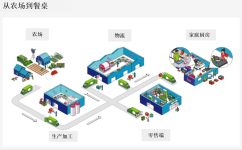
From farm to table: how does RFID technology carry the banner of food safety?
 chrispeng
 From Farm to Table: How RFID Technology Enhances Food Safety Across the Supply Chain
Modern consumers demand complete transparency about the food they purchase. Information such as manufacturer details, processing methods, ingredient sources, and handling conditions must be readily accessible and verifiable. RFID technology, combined with blockchain systems, provides a robust infrastructure to meet these expectations. As an RFID manufacturer, we design smart label solutions that track products from farm to table, enabling real-time visibility, rapid problem identification, and reduced waste.
Technical Foundation: How RFID Enables End-to-End Traceability
RFID (Radio Frequency Identification) uses electromagnetic fields to automatically identify and track tags attached to objects. Unlike barcodes, RFID does not require line-of-sight scanning, allowing bulk reading of multiple items simultaneously. Each tag carries a unique digital identifier (EPC) that can store or link to detailed product information such as batch number, harvest date, processing location, and temperature logs.
Frequency Bands and Their Applications in Food Supply Chains
UHF RFID (860–960 MHz) offers long read ranges (up to 10 meters) and high-speed bulk reading, making it suitable for pallet and case-level tracking in warehouses and logistics. HF/NFC RFID (13.56 MHz) provides shorter read ranges (up to 10 cm) and is ideal for item-level tagging where consumer interaction via smartphones is desired. For perishable food items, we recommend UHF tags for supply chain visibility and NFC tags for consumer engagement at the point of sale.
Blockchain Integration for Immutable Data Sharing
RFID tags capture data at each supply chain node: farm, processing plant, distribution center, and retail store. This data is written to a blockchain system, creating an immutable ledger that all authorized parties can access. The combination ensures that information cannot be tampered with, providing a trustworthy record from origin to consumer. Smart contracts can automate actions such as payment release upon verified delivery or quality checks based on sensor data.
Real-World Applications in Food Safety
Fresh Produce Tracking
RFID tags attached to crates or individual items record harvest dates, field location, and pesticide usage. During transportation, temperature and humidity sensors in the tags monitor storage conditions. If a deviation occurs, the system triggers alerts, allowing corrective actions before spoilage. In recall scenarios, the blockchain enables precise identification of affected batches, removing only contaminated products instead of entire lots.
Meat and Poultry Traceability
The meat industry benefits from item-level RFID tagging that links each carcass to its origin, slaughter date, and processing steps. This granularity supports compliance with food safety regulations and enables rapid traceback during disease outbreaks. Retailers can display provenance information via NFC tags, building consumer trust.
Dairy and Cold Chain Management
Milk and cheese require strict temperature control. RFID tags with integrated temperature sensors record the thermal history of each container. If the cold chain is broken, the tag stores the event, and blockchain records the failure. This data helps identify weak points in logistics and reduces waste from temperature-abused products.
Seafood and Imported Goods
For imported seafood, RFID tags can store catch location, vessel information, and processing dates. Customs authorities and retailers can verify authenticity and legality, combating fraud and illegal fishing. Consumers can scan a QR code linked to the blockchain to view the entire journey.
Deployment Considerations for RFID in Food Supply Chains
Tag Selection and Material Compatibility
Food environments present challenges such as moisture, high temperatures, and physical abrasion. Tags must be encapsulated in materials that withstand these conditions. For wet produce, we recommend IP68-rated tags with food-grade silicone encapsulation. For frozen goods, tags designed for low temperatures ensure reliable performance.
Reader Infrastructure and Placement
Fixed readers at choke points (e.g., conveyor belts, dock doors) provide automated data capture. Handheld readers are useful for spot checks. Antenna placement must account for product density and container materials. We advise conducting a site survey to optimize read rates and avoid metal or liquid interference.
Data Management and Integration
RFID generates massive data volumes. An edge computing layer can filter and aggregate data before sending it to the blockchain. Integration with existing ERP and WMS systems ensures seamless workflow. APIs allow retailers and consumers to access traceability data through mobile apps or web portals.
Product Selection Guidance
Choosing the right RFID solution depends on the specific application:
- For case-level tracking in warehouses: UHF RFID labels with high read range and durability. Look for tags with EPC Class 1 Gen2 compliance and memory sufficient for serialized data.
- For item-level consumer engagement: NFC tags that work with standard smartphones. Ensure NFC tags comply with ISO 14443 or ISO 15693 standards.
- For cold chain monitoring: Tags with integrated temperature sensors and data logging capabilities. UHF or HF depending on read range needs.
- For reusable containers and pallets: Hard-case RFID tags designed for multiple use cycles. Consider tags with high impact resistance and reusability.
Industry Insights: Retail, Logistics, and Manufacturing
Retail
RFID enables inventory accuracy above 98%, reducing out-of-stocks and shrink. For food retailers, real-time visibility into expiry dates helps implement FEFO (First Expiry First Out) rotation, minimizing waste. Smart shelves with integrated readers can alert staff when products near expiration, enabling markdowns or donations.
Logistics
Logistics providers use RFID to automate receipt and shipment verification. Combined with blockchain, they can offer customers verifiable proof of delivery and condition. This reduces disputes and enhances service quality. Third-party logistics companies can offer premium services for temperature-sensitive goods using RFID monitoring.
Manufacturing
Food manufacturers integrate RFID at production lines to track raw materials through mixing, cooking, and packaging. Real-time data allows immediate detection of deviations, such as incorrect ingredient amounts or temperatures. This proactive approach prevents large-scale recalls and protects brand reputation.
Frequently Asked Questions
1. How does RFID improve food safety compared to barcodes?
RFID enables bulk, non-line-of-sight reading, capturing data from multiple items simultaneously. It supports real-time tracking and sensor integration, which barcodes cannot. This allows proactive monitoring of conditions like temperature, rather than relying on manual checks.
2. What is the typical read range for RFID tags in food applications?
UHF tags offer read ranges up to 10 meters, ideal for pallet and case tracking in warehouses. HF/NFC tags have ranges under 10 cm, suitable for item-level consumer interaction. Selection depends on application requirements.
3. Can RFID tags be used on metal or liquid food containers?
Yes, but special tags are required. Metal reflects RF signals, and liquids absorb them. We offer tags with impedance-matched designs and foam spacers to mitigate these effects. For liquid products, consider on-metal tags or tags designed for high-dielectric environments.
4. How much data can an RFID tag store?
UHF tags typically have 96–512 bits of user memory, sufficient for EPC and limited sensor data. For larger data sets, tags can store a unique identifier that links to cloud-based records. NFC tags can hold up to 8 KB, allowing product information to be stored directly on the tag.
5. Is RFID cost-effective for small-scale food producers?
Cost per tag has decreased significantly, with UHF tags under $0.10 in volume. For small producers, we recommend starting with case-level tagging to minimize investment while gaining traceability benefits. Cloud-based software with pay-per-use models reduces upfront costs.
6. How does blockchain protect RFID data from tampering?
Blockchain creates an immutable, time-stamped record of each transaction. Once data is written, it cannot be altered without network consensus. This ensures that traceability information is trustworthy and auditable by regulators and consumers.
7. What challenges exist when deploying RFID in cold chain logistics?
Low temperatures can affect tag battery life for active tags. Passive tags perform well in cold environments but may experience signal absorption from ice or frost. Proper encapsulation and tag placement are critical. We recommend testing in actual cold chain conditions before full deployment.
8. Can consumers access RFID data using their smartphones?
Yes, NFC tags can be read by any NFC-enabled smartphone. Consumers simply tap the phone to the tag to view product information, including origin, processing details, and certifications. For UHF tags, consumers can scan QR codes printed on labels that link to the blockchain record.
Conclusion
RFID technology is a cornerstone of modern food safety systems. By providing unique digital identities, enabling real-time monitoring, and integrating with blockchain for immutable records, RFID creates a transparent and accountable supply chain from farm to table. As a manufacturer, we are committed to delivering reliable, cost-effective RFID solutions that help food producers, processors, retailers, and logistics providers enhance safety, reduce waste, and build consumer trust. Whether you are just starting your traceability journey or looking to upgrade existing systems, our expertise can guide you to the right solution for your specific needs.