
 chrispeng
 “`html
RFID Washable Tags Complete Guide for Laundry and Linen Management
In the high‑volume world of industrial laundry and textile rental, tracking every single item from collection to delivery has traditionally been a labour‑intensive and error‑prone process. RFID washable tags have changed that paradigm entirely. By embedding a durable, waterproof UHF RFID tag into each garment or linen item, operators can automate sorting, inventory, and quality control – reducing manual handling by up to 80 % while virtually eliminating misplacements.
This article provides a manufacturer‑level look at how RFID washable tags work, how they integrate into a complete laundry workflow, and what you need to consider when selecting the right tag for your application.
Technical Overview of RFID Washable Tags
An RFID washable tag is not a standard sticker. It must withstand repeated exposure to water, high temperatures (up to 90 °C in industrial washing), strong detergents, bleach, and mechanical stress during tumble drying and ironing. Typical construction includes:
- Encapsulated microchip and antenna – usually a UHF (860–960 MHz) chip encased in a flexible polymer or silicone.
- Fabric or textile carrier – the tag is often sewn into a hem or pocket, or inserted into a dedicated sleeve.
- Sealing layer – prevents moisture ingress and chemical attack.
The most common form factors are button‑shaped tags (often referred to as “laundry buttons”) and flexible label‑shaped tags that can be sewn directly into seam areas. Both types carry a globally unique identifier (UID) that links to a database record containing the item’s type, size, department, owner, and wash history.
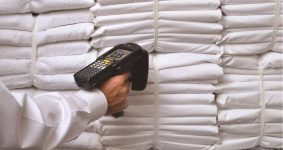
For reading these tags, operators rely on industrial RFID readers that can batch‑scan dozens of items in a single pass – a critical capability in a busy laundry environment.
Workflow Integration in Laundry Management
1. Pre‑Recording and Tagging
Before any garment enters service, it is fitted with a washable RFID tag. During this “pre‑record” phase, the following data is registered in the central database:
- Clothing number (UID)
- Clothing name and category
- Department or cost centre
- Owner or user
- Remarks (e.g., special care instructions)
A handheld reader then verifies that each tag is correctly encoded and linked to the correct record. This step ensures that every item is traceable from day one.
2. Dirty Sorting and Intake
When soiled garments arrive at the laundry, they are placed on a conveyor or in a bin equipped with a fixed‑mount RFID reader. The system reads every tag simultaneously, queries the database, and displays the item’s details on a screen. This allows operators to:
- Confirm the item was pre‑recorded
- Detect misplaced items (e.g., a towel mixed with uniforms)
- Automatically record intake time, date, and operator ID
- Print a receiving voucher for audit trails
3. Post‑Wash Sorting and Dispatch
After washing, drying, and ironing, the clean items pass through another RFID read zone. The system identifies each item, verifies that it has completed the correct wash cycle, and groups it by department or destination. The outbound process records the same metadata, creating a complete chain of custody.
This automated sortation eliminates the need for manual counting and reduces disputes between the laundry and its customers – a common pain point in rental and healthcare linen services.
4. Statistical Reporting and History Tracking
All wash events are stored in the database, enabling managers to generate reports on:
- Wash frequency per item
- Item lifespan and replacement forecasting
- Productivity of laundry operators
- Cost per item per wash cycle
Historical queries are fast: simply scan a tag or enter its UID to retrieve every wash record for that item.
Real‑World Applications
RFID washable tags are deployed across multiple sectors where textile hygiene, traceability, and asset utilisation are critical:
- Healthcare – Hospital gowns, bed linens, surgical drapes, and staff uniforms must be tracked to ensure proper sterilisation and to prevent cross‑contamination.
- Hospitality – Hotels and resorts use RFID to manage towels, bathrobes, and table linens, reducing replacement costs by optimising usage cycles.
- Industrial workwear – Factories and clean‑rooms require that flame‑retardant or anti‑static garments are washed correctly and replaced according to safety schedules.
- Linen rental services – Companies that lease linens to multiple clients rely on RFID to automate billing and return verification.
In each case, the core benefit is the same: batch scanning. Traditional barcode systems require each item to be handled individually, which is slow and labour‑intensive. RFID can read 100+ tags in under two seconds, even when the items are stacked, folded, or packed in bags.
Deployment Considerations
While the benefits are clear, successful deployment of RFID washable tags requires careful planning:
- Tag durability – Not all washable tags survive the same number of cycles. For hospital environments where autoclaving is required, choose tags rated for >200 industrial wash cycles at 90 °C.
- Reader placement – Fixed readers in conveyor tunnels provide the highest throughput, but handheld readers are essential for spot‑checks and returns. Ensure the chosen RFID reader manufacturer offers models with appropriate IP ratings for wet environments.
- Data integration – The RFID system must connect to your existing laundry management software (LMS) or ERP. Most modern readers support standard interfaces (MQTT, REST API, or direct database writes).
- Tag attachment method – Sewn‑in tags are most secure for garments, while adhesive or snap‑fit tags work well for flat linens. Always test the attachment with your specific fabric type.
For a deeper look at how different RFID tags on clothes perform in real‑world conditions, consult a manufacturer’s test data before committing to a design.
Product Selection Guidance
When selecting an RFID washable tag, evaluate the following parameters:
| Parameter | Recommendation |
|---|---|
| Operating frequency | UHF (860–960 MHz) for global compliance and long read range |
| Wash durability | ≥200 cycles at 90 °C for hospital use; ≥100 cycles for hospitality |
| Chip type | Impinj Monza R6 or NXP UCODE 8 for high‑speed batch reading |
| Form factor | Button tag for thick textiles; label tag for thin or delicate fabrics |
| Attachment | Sewn for permanence; heat‑seal or adhesive for temporary use |
For applications requiring NFC compatibility (e.g., on‑garment user interaction), comparing NTAG213 vs NTAG215 can help you decide which chip provides the right balance of memory and performance.
Industry Insights
The global RFID textile management market is projected to grow at over 15 % CAGR through 2030. Key drivers include:
- Labour shortages – Automation through RFID reduces dependence on manual sorting staff.
- Sustainability mandates – Precise tracking extends textile life, reducing waste and chemical usage.
- Regulatory pressure – In healthcare, standards such as HTM 01‑01 and EN 14065 increasingly require traceable linen management.
Forward‑thinking laundry operators are also combining RFID with IoT sensors to monitor wash‑cycle conditions (temperature, chemical dosing, drum speed) in real time, creating a fully digital twin of the laundry process. This convergence of RFID and industrial IoT is the next frontier for the industry.
Frequently Asked Questions (FAQ)
1. How many wash cycles do RFID washable tags typically last?
Premium tags are rated for 200+ industrial wash cycles at 90 °C. Lower‑cost tags may last 50–80 cycles. Always verify the manufacturer’s test data for your specific wash chemistry and temperature profile.
2. Can RFID tags survive dry cleaning?
Yes, many UHF washable tags are also resistant to dry‑cleaning solvents. However, you should confirm chemical resistance with the supplier, as perchloroethylene (PERC) can degrade some sealants over time.
3. Do I need a special reader for washable tags?
Standard UHF RFID readers work with washable tags. However, in wet or humid environments, choose readers with an IP65 or higher rating. Handheld readers are useful for returns and spot‑checks, while fixed tunnel readers maximise throughput.
4. Can I reuse a washable tag on a different garment?
Technically yes, but the tag’s service life is consumed with each wash. Reusing a tag on a new garment is only practical if the tag has sufficient remaining cycles. Most operators discard the tag with the garment.
5. How do I attach a washable tag to a garment?
Button tags are sewn on like a standard button. Label‑shaped tags are sewn into a hem or inside a pocket. Some suppliers also offer heat‑seal or adhesive versions for temporary applications.
6. Will the RFID tag cause discomfort to the wearer?
Modern tags are designed to be thin and flexible. When sewn into a seam or hem, they are generally imperceptible. Button tags are best placed on areas that do not contact the skin directly (e.g., collar, cuff, or waistband).
7. Can I read tags through plastic laundry bags?
UHF signals can penetrate thin plastic bags (e.g., polypropylene) with minimal loss. Thick or metallised bags will attenuate the signal and reduce read range. Test your specific bag material in a pilot deployment.
8. What data should I store on the tag versus in the database?
Store only the unique identifier (UID) on the tag. All dynamic data (last wash date, cycle count, department) should reside in the database. This keeps the tag simple, low‑cost, and reusable across different backend systems.
Conclusion
RFID washable tags are a proven, cost‑effective solution for modern laundry and linen management. By enabling batch scanning, real‑time tracking, and detailed analytics, they transform a traditionally manual operation into a streamlined, data‑driven process. Whether you manage a hospital laundry, a hotel linen service, or an industrial workwear rental fleet, investing in the right RFID tag and reader infrastructure will deliver measurable returns in efficiency, accuracy, and asset longevity.
“`