
 chrispeng
 “`html
RFID-Based Wireless Medical Care: Enhancing Patient Safety Through Closed-Loop Systems
In the complex ecosystem of a modern hospital, the margin for error is slim. For decades, healthcare institutions have struggled with a persistent challenge: preventing medical errors that compromise patient safety, damage institutional reputations, and result in significant financial losses. Traditional methods, reliant on manual checks and paper-based verification, often fall short in high-pressure environments. The integration of wireless network technology with Radio Frequency Identification (RFID) offers a transformative approach, enabling real-time verification and closed-loop control that fundamentally changes how care is delivered at the bedside.
When a patient moves from diagnosis to treatment, three critical steps occur: a doctor examines the patient and issues an order; a nurse interprets and transcribes that order; and the nurse administers the treatment. Each step relies on accurate information transfer. Errors at any point—an illegible order, a misread chart, or an incorrect patient identification—can have catastrophic consequences. This article explores how an RFID-based wireless nursing information system provides a robust, manufacturer-grade solution to these challenges, ensuring the Five Rights of medication administration: the Right Patient, the Right Drug, the Right Dose, the Right Route, and the Right Time.
The Critical Challenge of Medical Errors in Healthcare
The traditional healthcare workflow, even with Hospital Information Systems (HIS), often operates as an open-loop process. While a doctor’s order might be entered digitally, the subsequent steps—who executed the order and exactly when—lack objective, real-time verification. Widely used verification methods, such as the manual “three checks and seven pairs” system, are labor-intensive and prone to human error, especially under heavy workloads. This creates substantial risks, including transfusion errors, medication mix-ups, and even wrong-site surgery.
These errors are not just clinical failures; they erode patient trust and impose heavy financial burdens on healthcare systems. The need for a proactive, technologically driven solution has never been more urgent. By deploying a wireless local area network (WLAN) and integrating RFID into the nursing workflow, hospitals can create a verifiable digital audit trail for every action taken on a patient’s behalf. This transition from an open-loop to a closed-loop system is the cornerstone of modern patient safety initiatives.
RFID Technology as a Foundation for Patient Safety
Radio Frequency Identification (RFID) is a powerful technology that uses electromagnetic fields to automatically identify and track tags attached to objects. An RFID system consists of two primary components: the tag (or transponder), which carries data, and the reader (or interrogator), which captures that data. Unlike barcodes, which require a direct line of sight and manual scanning, RFID enables rapid, contactless communication. This makes it exceptionally well-suited for the demanding medical environment.
How RFID Systems Work in Medical Settings
In a healthcare setting, patients wear RFID wristbands containing a unique identifier. Medications, blood bags, and even equipment are similarly tagged. When a nurse initiates a procedure, a handheld RFID reader communicates with the wristband and the medication tag simultaneously. The system instantly verifies the match against the HIS database. If a mismatch is detected—such as the wrong medication or an incorrect dosage—the system triggers an immediate alert, preventing the error from reaching the patient.
RFID offers several advantages over traditional barcodes in medical applications. It can read multiple tags at once, drastically speeding up processes like inventory management. Furthermore, RFID tag data can be updated and rewritten, and the tags themselves are inherently more durable, resisting damage from moisture, alcohol wipes, and wear. For mission-critical applications, a reliable RFID tag designed for medical use provides the unique, tamper-evident identification required to guarantee patient safety.
Designing an RFID-Based Wireless Nursing Information System
Implementing a successful RFID-based wireless nursing information system requires careful planning of both hardware and software components. The goal is to create a seamless, intuitive system that enhances, rather than hinders, the clinical workflow.
System Architecture and Workflow
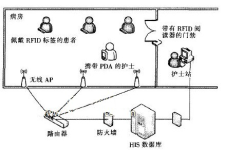
A typical deployment involves a ward equipped with wireless Access Points (APs). Nurses carry a PDA or mobile computer integrated with an RFID Reader. This reader communicates with patient wristbands and medication tags. The PDA interfaces with the central HIS over the secure wireless network, pulling down patient orders and pushing up real-time administration data. As shown in the standard workflow, a nurse logs in, selects a patient, reads their wristband, reads the medication, and the system confirms the match. This entire process takes seconds but adds a formidable layer of safety.
Hardware Components for Medical RFID Deployment
The efficacy of the system rests on the quality and suitability of the hardware. Key components include:
- RFID Tags (Wristbands and Labels): These must be biocompatible, durable, and secure. They are typically passive (powered by the reader) and operate at HF (13.56 MHz) for optimal read range in proximity applications.
- Handheld Readers (PDAs): These require an integrated RFID module, a robust construction to withstand hospital cleaning, and an ergonomic design for frequent use.
- Fixed Readers (Access Points): These can be installed at ward entrances for automatic patient flow tracking or in medication rooms for inventory management.
- RFID Label Printers: On-demand printing allows for the encoding and personalization of wristbands and medication labels at the point of care.
Software Integration and Data Management
Software is the brain of the operation. The nursing application must seamlessly integrate with the existing HIS database through drivers like ODBC. It needs to manage patient admissions, transfers, and discharges (ADT), process medical orders, and record real-time administration data. Essential modules include patient management, drug management, medical order processing, data management, and a knowledge base for nursing queries. The software must provide robust data backup and synchronization to ensure data integrity and security.
Real-World Applications of RFID in Nursing Workflows
The theoretical benefits of RFID translate directly into improved clinical outcomes and operational efficiencies. Here are key applications within the wireless nursing information system:
Patient Identification and Tracking
Every patient is admitted with a unique RFID wristband. This instantly identifies them anywhere in the hospital. Access control systems integrated with the RFID readers can automatically log patient movements, providing valuable data for workflow optimization and safety monitoring. When RFID tags are used on patient belongings, it further reduces the risk of loss and misidentification. For specialized applications like managing hospital linen and patient gowns, dedicated RFID tags on clothes are designed to withstand repeated industrial laundry cycles while maintaining read reliability.
Medication and Blood Bag Verification
This is the most critical safety application. Before administering any medication or blood product, the nurse scans the patient’s wristband and then the drug bag or container. The system instantly cross-references the two IDs. It confirms the “Five Rights” and records the exact timestamp and identity of the administering nurse. This closed-loop process eliminates the possibility of giving one patient’s medicine to another and ensures that high-risk procedures like blood transfusions are failsafe.
Closed-Loop Medical Order Execution
The closed-loop system provides an audit trail from the moment a doctor places an order to when it is executed. The system knows exactly what tasks are pending and for which patients. It directs the nurse to the correct actions, reducing reliance on memory and paper lists. Once a task is completed, the HIS is updated in real-time, providing complete visibility to clinicians. This dramatically reduces the risk of missed or double-dosed medications.
Product Selection Guidance for Healthcare RFID Systems
Choosing the right products is crucial for a successful RFID deployment. A one-size-fits-all approach does not work in the diverse environment of a hospital.
Tag Selection: The choice of tag depends on the application. For patient wristbands, comfort, skin safety, and tamper-evident features are paramount. For medication labels, small form factors with high reliability are required. For asset tracking, rugged tags with long read ranges (UHF) are often used. Understanding the nuances of tag specifications, such as memory size and protocol, is important. For instance, when developing NFC-based mobile verification applications, understanding the differences between NTAG213 vs NTAG215 is key to balancing cost against functionality and memory requirements.
Reader Selection: Handheld readers need to be lightweight, durable, and have long battery life. Fixed readers must offer robust performance and easy integration with network infrastructure. As an RFID reader Manufacturer, we emphasize the importance of comprehensive testing and support. Choosing a partner who can provide customized antennas, firmware, and technical support is often the difference between a pilot project and a hospital-wide success. You must ensure the reader can reliably communicate with your chosen tags in the challenging RF environment of a hospital, which is filled with metal, liquids, and electronic interference.
Deployment Considerations in a Hospital Environment
Deploying an RFID-based nursing system is a significant undertaking. Success requires meticulous planning in several areas:
- Wireless Network Infrastructure: A robust, secure WLAN is non-negotiable. The network must support the data load from hundreds of handheld devices simultaneously without latency or dead zones.
- Workflow Integration: The system must align with existing clinical workflows. Forcing a disruptive process will lead to staff resistance. The best systems are designed with extensive input from frontline nursing staff.
- Staff Training: Comprehensive training is essential to ensure high adoption rates. Nurses must understand not just *how* to use the system, but *why* it makes their patients safer.
- Data Security and Privacy: Patient data is highly sensitive. The RFID system must encrypt data at rest and in transit. Adherence to strict access control protocols and compliance with regulations like HIPAA or GDPR is mandatory.
- Durability and Hygiene: Hardware must withstand constant use and rigorous cleaning protocols with harsh disinfectants.
Industry Insights and Future Trends
The role of RFID in healthcare is expanding rapidly. Beyond patient safety, RFID is a cornerstone of the “smart hospital” concept. We see significant growth in the use of Real-Time Location Systems (RTLS) for tracking critical assets like infusion pumps and wheelchairs, saving nursing staff hours of search time. Integrating RFID data with Electronic Health Records (EHRs) and AI-driven analytics platforms opens new frontiers in predictive health monitoring and operational intelligence.
Future trends include the increased use of sensor-augmented tags that can monitor temperature (for cold chain management of vaccines and biologics) or patient movement (for fall prevention). The convergence of RFID with IoT and cloud computing will create more centralized, data-rich platforms that provide a truly holistic view of hospital operations. The goal is a fully integrated, intelligent environment where technology works silently in the background to support clinical excellence.
Frequently Asked Questions (FAQ)
1. How does RFID improve patient safety compared to barcodes?
RFID does not require a direct line of sight, allowing for quicker and more reliable scanning, especially in emergency situations. It can read multiple tags simultaneously (e.g., scanning a patient wristband and multiple medication bags at once). RFID tags are also more durable and offer higher data storage capacity, and data can be encrypted for enhanced security, creating a more robust safety net against errors.
2. What is a closed-loop medication administration system?
A closed-loop system verifies the “Five Rights” of medication administration electronically. The system uses RFID to confirm the right patient, right drug, right dose, right route, and right time, and records these data in real-time. If a mismatch occurs, the system alerts the nurse, preventing a potential error before it happens. This creates a complete digital audit trail from order to administration.
3. What type of RFID tag is best for patient wristbands?
For patient identification, passive High-Frequency (HF) 13.56 MHz tags are the industry standard. They offer an optimal read range for wristband scanning (typically a few centimeters to inches) and are less susceptible to interference from bodily fluids and metal. Modern wristbands use biocompatible, hypoallergenic materials and tamper-evident designs to ensure patient comfort and security. Choosing a durable, medical-grade RFID tag is critical for long-term use.
4. Can RFID be used for asset tracking in hospitals?
Absolutely. This is one of the most common and effective uses of RFID. By attaching rugged RFID tags to high-value assets like infusion pumps, ventilators, and wheelchairs, hospitals can use a network of fixed readers to instantly locate equipment. This drastically reduces the time nurses spend searching for equipment, improves asset utilization, and reduces inventory costs.
5. What are the main challenges of deploying RFID in a hospital?
The primary challenges include ensuring a robust and secure wireless network, integrating RFID data seamlessly with legacy HIS/EHR systems, managing the change in clinical workflow to ensure staff buy-in, and guaranteeing the physical durability of hardware against hospital-grade cleaning agents and harsh environments. Choosing an experienced partner who understands the clinical environment is key to overcoming these hurdles.
6. How does RFID integrate with existing Electronic Medical Records (EMR/EHR)?
Integration is typically done through standard interfaces like HL7 or APIs (Application Programming Interfaces). The RFID middleware captures the data (e.g., “Patient A scanned, Medication B scanned, Match Confirmed”) and formats it into a message that the EMR/EHR system can understand. This allows the verified administration record to be automatically documented in the patient’s chart without manual entry.
7. Is RFID technology expensive for small clinics?
While initial investment can be higher than a paper-based system, the cost of RFID technology has decreased significantly. For small clinics, a modular system—starting with basic patient identification and medication verification—can offer an excellent return on investment by preventing costly malpractice risks and improving billing accuracy. The long-term savings from reduced errors and improved efficiency typically justify the initial expense.
8. What is the read range of a typical HF medical RFID tag?
For High-Frequency (13.56 MHz) medical RFID tags, such as those used in patient wristbands and medication labels, the typical read range is up to 10 cm (4 inches). This short, focused range is by design; it ensures that the nurse has to make a deliberate close swiping action to the patient’s wristband and the medication, significantly reducing the chance of reading the wrong tag by accident.
Conclusion
The transition from traditional, open-loop medical order execution to a closed-loop RFID-based system represents a monumental leap forward in patient safety and operational efficiency. By leveraging robust wireless infrastructure and reliable identification technology, healthcare providers can drastically reduce the risk of medical errors such as misidentification, medication mix-ups, and incorrect dosages.
The implementation of an RFID-based wireless nursing information system is not just a technological upgrade; it is a fundamental commitment to a standard of care where every action is verified, every dose is tracked, and every patient is confidently identified. From the initial product selection of durable tags and readers to the final deployment and staff training, a careful, informed approach ensures that the technology serves its ultimate purpose: protecting the patient. As technology evolves, the integration of RFID with artificial intelligence and advanced analytics will continue to make hospitals smarter, safer, and more responsive to patient needs, making the connected, error-free hospital a reality.
“`