
 chrispeng
 “`html
RFID Ticket Management System: Complete Guide to Secure Access Control & Anti-Counterfeiting
Event organizers, stadium operators, and transit authorities face a common challenge: how to process large volumes of ticketholders quickly while preventing counterfeiting, ticket sharing, and unauthorized access. Traditional paper tickets with barcodes or magnetic stripes are too easy to duplicate and too slow to verify. RFID ticket management systems solve these problems by embedding a unique, tamper-proof electronic identifier into every ticket, enabling automated validation, real-time tracking, and actionable audience analytics.
This guide explains how an RFID-based ticket management system works from a manufacturer’s perspective, covering system architecture, operational workflows, deployment considerations, and product selection criteria.
What is an RFID Ticket Management System?
An RFID ticket management system is an integrated access control platform that uses radio-frequency identification technology to validate tickets, monitor entry/exit events, and manage the movement of attendees across a venue. Unlike optical systems that require line-of-sight scanning, RFID communicates via radio waves, enabling hands-free, high-throughput verification even when tickets are kept inside wallets, bags, or pockets.
Each ticket contains a passive RFID inlay or label with a unique identifier (UID) that is permanently engraved into the silicon chip during manufacturing. This UID cannot be altered, copied, or overwritten, making it a reliable root of trust for anti-counterfeiting applications.
Core Architecture of an RFID Ticket Management System
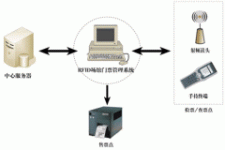
From a system design perspective, an RFID ticketing platform comprises three interdependent layers: the backend database, the ticketing (encoding) terminals, and the entry/exit readers. These components communicate through a central network to ensure data consistency from ticket issuance to final validation.
1. Backend Database – System of Record
The backend database stores all ticketing records, including ticket UIDs, ticket holder information, purchase timestamps, validity periods, entry/exit logs, and ticket status (valid, used, revoked, expired). When a ticket is sold, its UID is appended to a “whitelist” of legal tickets. When a ticket is presented at a gate, the reader queries this database — or a cached version of it — to confirm legality in real time.
Cloud-based database architectures are typical for modern systems, enabling multiple venues to share a single ticketing infrastructure and allowing organizers to deploy temporary entry gates without on-premises servers.
2. Ticketing Terminals – Encoding & Personalization
Ticketing terminals are RFID-enabled desktop printers or encoders that write data to the electronic label attached to each ticket. At the point of sale, the terminal:
- Reads the unique UID from the RFID inlay
- Writes the ticket holder’s name, certificate number, ticket category, validity period, and permitted number of entries onto the label (if the tag memory allows)
- Uploads all recorded information to the backend database
Choosing the right RFID tag is critical at this stage: the label must offer sufficient memory for personalization, reliable read range at gate distances, and a form factor that withstands printing and handling.
3. RFID Readers – Gate-Level Verification
RFID readers installed at venue entrances capture the electronic label information from each ticket and transmit it to the backend system for real-time verification. Two reader configurations dominate:
- Handheld readers – Used for mobile patrol, VIP lane verification, and random spot checks
- Fixed UHF gate readers – Integrated into turnstiles or portal gates for high-volume, automated access control
Selecting a reliable RFID reader is essential for achieving fast, error-free ticket validation at scale. High-performance readers also need to handle dense tag populations and avoid cross-read interference between adjacent gates.
RFID Ticket Anti-Counterfeiting: Step-by-Step Business Process
The anti-counterfeiting advantage of RFID goes well beyond the inability to photocopy a paper ticket. The full workflow consists of four stages:
Stage 1 – Information Binding
Each RFID anti-counterfeiting ticket is produced with a unique, unchangeable ID number burned into the chip during fabrication. This UID is the anchor for all downstream verification. The ticket is bound to its printed visual data (event name, seat number, date), and the relationship is stored in the database.
Stage 2 – Ticket Sales and Activation
When a ticket is sold, the system writes purchase-specific information into the tag memory: buyer name, certificate/ID number, event validity period, and the number of allowed entries. Simultaneously, the ticket UID is added to the list of “legal tickets” in the database. This two-step process — physical encoding plus database registration — prevents the creation of valid tickets without an authorized sales transaction.
Stage 3 – Ticket Verification at Entry
At the venue entrance, readers interrogate the ticket in passing. The verification workflow compares the information stored on the tag with the matching record in the backend database. Two levels of validation are possible:
- Anonymous verification – For events where identity is not required. The system checks whether the ticket UID exists in the legal list and whether the ticket is still valid.
- Identity verification – For security-sensitive venues such as airports or government events. The system performs a biometric or certificate crosscheck between the ticket holder and the personal data stored in the database.
In both cases, the entire validation cycle completes in a fraction of a second. Valid tickets trigger the opening of the access gate; invalid, expired, or blacklisted tickets trigger an alarm or a visual indicator for security staff.
Stage 4 – Real-Time Monitoring and Data Analytics
After each ticket check, the reader instantly uploads transaction data (entry time, gate ID, ticket UID, entry/exit direction) to the central server. Data analytics software running on the server summarizes these records, giving operators live visibility into:
- Total attendance vs. sold tickets
- Zone occupancy density
- Peak arrival times
- Unusual dwell times or movement patterns
- Rate of ticket reuse attempts
Key Functional Capabilities of an RFID Ticketing Platform
Ticket Identification & Authentication
The core function is instant ticket identification through a reader. Unlike magnetic stripe or barcode systems, RFID does not require direct contact or optical alignment, so ticket inspection efficiency can increase by 300–500% compared to manual verification, making it feasible to process large crowds in sports competitions, music festivals, and exhibitions.
Audience Tracking, Positioning & Query
Electronic tickets can be used to create zone-based access permissions. When a ticketholder enters a restricted zone, the nearest reader captures the event and forwards it to the management system. Staff can query the current location of a particular attendee or generate a movement history for security purposes.
Critical Area Security Control
For backstage zones, pits, media areas, or VIP lounges, the system summarizes and analyzes access patterns. Security teams can determine who enters which area, how often, at what times, and for how long. Abnormal behavior — such as an attendee repeatedly entering a restricted zone — triggers an alert for immediate intervention.
Regional Data Analysis & Crowd Flow Management
By analyzing the number of personnel, flow rate, and peak periods in a given area, operators can predict overcrowding before it becomes dangerous. When density exceeds a preset threshold, the system recommends opening additional exit channels or dispatching extra staff to prevent bottlenecks and stampede risks.
Security Patrol Management
The same RFID infrastructure can support guard patrol management. Security personnel carry handheld readers that scan checkpoints tagged with RFID labels, and the system records each patrol route in real time. This creates an auditable trail of security activity and ensures that patrol rounds are consistently completed.
Technical Advantages of RFID Over Traditional Ticketing
1. Unmatched Security and Tamper Resistance
RFID electronic tags have security properties that paper tickets cannot match:
- The electronic tag chip has a unique UID that is hard-coded at manufacture and cannot be modified or cloned
- Encrypted data storage and mutual authentication between reader and tag prevent unauthorized reading or writing
- No mechanical wear, pollution-resistant encapsulation, and damage detection make tampering obvious
- Low-cost counterfeiters cannot afford the chip design and foundry access required to replicate tags
2. Rapid Gate Throughput
In large-scale events, RFID readers can process 50–100 ticket holders per minute per lane, even with tickets inside a wallet or held at a 45-degree angle. For comparison, manual visual inspection typically handles 10–15 people per minute, while barcode scanning requires exact optical alignment.
3. Built-In Reuse Prevention
By writing a “usage count” into the ticket label, the system detects if the same ticket is presented more than the allowed number of times. This blocks ticket “pass-back” fraud, where one person exits an event and hands the entry ticket to someone outside to reuse.
4. Real-Time Visibility
Every ticket check is time-stamped and attributed to a specific gate. Operators can monitor the status of every RFID ticket in use, identify unusual patterns in real time, and generate forensic reports after the event ends.
Deployment Considerations for RFID Event Ticketing
Rolling out an RFID ticketing system requires attention to both hardware and environmental factors. The following points are based on common field deployment experience across stadium deployments, theme parks, and industrial access facilities.
Antenna and Reader Positioning
Correctly positioning antennas is the single biggest factor affecting detection accuracy at gates. For UHF systems, antennas should be mounted to create a confined detection zone that does not extend beyond the gate lane. Otherwise, adjacent gates may pick up the same ticket, causing miscounting of entries and exits. Site surveys measuring signal propagation are recommended before mounting equipment.
Environmental Interference
Metal door frames, concrete walls containing rebar, and large lighting modules can detune antenna systems or reflect RF signals. Designers should verify that entrance materials do not degrade reader sensitivity. Testing with the actual ticket media worn or carried in different positions (chest, waist, bag) dramatically reduces surprises on event day.
Ticket Media Form Factor
What “ticket” actually means in the physical world is a wide spectrum:
- Pape-based RFID tickets – Lowest cost per unit; suitable for single-use events
- PVC cards – More durable; suitable for season passes
- Wristbands – common in festivals and water parks
- Access control labels on lanyards – easy to scan when worn by attendees
For events, the optimum choice is a custom label whose size, antenna design, and paper substrate match the print quality and read distance requirements of the project. Manufacturers with experience in custom RFID stickers can adjust antenna geometry, adhesive, and face stock for event-specific conditions.
Data Integrity Fallback
Network outages at gates are an operational risk. A robust ticket management system must include an offline validation fallback — for example, storing a mirrored whitelist locally with a read-only comparison mode — so gate attendants can continue processing attendees during connectivity interruptions. Once the network is restored, all local log data should synchronize to the central server.
Fail-through vs. Fail-closed Settings
For events like concerts, a fail-closed approach (gate remains locked unless ticket validation succeeds) may be too aggressive when a reader fails. Many operators set gates to fail-open at public entrances while keeping fail-closed settings for restricted zones. This decision must be made during the specification phase, not on the day of the event.
RFID vs. NFC for Ticketing Applications
Project teams often confuse RFID and NFC because both use radio-frequency communication. For ticketing, the distinction influences product cost and reader infrastructure:
- UHF RFID (860–960 MHz) – Offers read ranges of 2 to 8 meters (or more in controlled conditions), enabling walk-through portal gates and broad-zone detection. This is the protocol of choice for stadium entrances, transit tap-in/tap-out gates, and vehicle queue management.
- High-frequency RFID (13.56 MHz, including NFC-compatible standards) – Offers short-range communication up to 10 cm (NFC) or 1 meter (HF proximity). Tickets can be presented as smart cards or via mobile phones.
When mobile wallet integration is a requirement, architects must configure the system to read the same ISO 14443 / ISO 15693 HF standards used by Android and iOS devices. On the other hand, when bulk simultaneous read or extra-long read range is required, UHF is appropriate. Understanding the detailed differences between the two technologies helps align ticket design with the intended user experience.
Product Selection Guidance for RFID Ticketing Systems
What to Evaluate When Choosing an RFID Tag Manufacturer
- Inlay consistency: Ensure high-yield lot-to-lot consistency on antenna resonance and read range
- Memory architecture: Verify that the tag chip offers appropriate memory banks for unique identifier and application data
- Printability: Verify compatibility with thermal transfer, inkjet, or offset print processes used on tickets
- Performance at event scale: Test at least 10,000 tags continuously through the encoding process to catch early-failure anomalies
How to Choose Between Tag ICs
Where personalization data is limited to a simple ticket identifier, a basic UHF chip like the Impinj Monza line is preferred. Where the ticket has concession entitlements or multi-visit usage logic to store (for example, a three-day festival pass), more memory is required. In HF band projects, open formats (such as NTAG213 or NTAG215) are often used for short-distance ticket validation; the chip selection affects both usable memory and read performance and is an important comparison for the system integrator.
Read more: NTAG213 vs NTAG215 – Choosing the Right NFC Tag for Your Project.
Readers and Infrastructure Selection
Avoiding a single point of failure in the reader infrastructure is essential. In major ticketing installations, network switches, antenna cables, and power supplies should be redundantly routed. Typical turnkey deployments include fixed UHF readers from established RFID reader manufacturers with API integration to the event platform, ensuring robust and repeatable procurement for installers and end users.
Beyond Paper Tickets – Wearable RFID
Wearables are increasingly part of large events. Some ticketing platforms are converging with laundry or visitor identification systems, where the same tag architecture is used for authorization on different items. RFID tags embedded in clothes are useful in advanced access management scenarios, enabling credential chips to be sewn directly into staff uniforms or VIP jackets and read without any visible ticket. See more in our complete guide to RFID tags on clothes.
Real-World Application Scenarios
Stadiums and Large-Scale Sports Events
RFID ticket management systems allow a stadium to validate 70,000 tickets in under 45 minutes. In addition, the system provides a clear view on stadium gate queue lengths, so the operator can proactively redirect attendees to less congested gates.
Theme Parks and Multi-Day Festivals
Ski resorts and theme parks use RFID tickets that persist over several days. The usage counter prevents unauthorized sharing between visitors while allowing re-entry for flexible day schedules. Real-time zone data also lets park managers understand which attractions are oversubscribed.
Transit and Commuter Access
Rail operators use high-speed RFID gates that read the ticket while the passenger is in motion. In high-frequency networks, low-cost tickets are paired with reusable card fare media to reduce waste and operational expenses.
Corporate and Industrial Access Control
For factory plants and corporate campuses, RFID badges double as attendance tracking and secure perimeter access. The same ticketing logic used for special events can be applied to daily employee movement in restricted manufacturing environments.
Frequently Asked Questions (FAQ)
1. How does RFID ticket anti-counterfeiting differ from QR code anti-counterfeiting?
QR codes are visual copies. They can be photographed, printed, or shared digitally. RFID chips contain a unique UID hardened in silicon that cannot be cloned at the consumer level. Moreover, RFID supports encrypted mutual authentication, so the system confirms not only the data content but also the chip authenticity. This protects against systematic copying attacks that bypass printed visual inspection.
2. What read range is required for an RFID ticket gate?
For walk-through gates in stadiums, UHF RFID read ranges of 1–3 m are usually sufficient. Longer ranges (up to 6 m) may be needed for drive-through access or zone-based tracking. Using a longer read range than required raises the risk of cross-reading and reader collision.
3. Can an RFID ticket be read if it is in a wallet or purse?
Yes. This is one of the advantages of RFID: it works without line of sight. However, metals (aluminum-lined wallets or foil-lined bags) can shield the signal. In such cases, the ticket holder must remove the ticket from the wallet for the subsequent read attempt.
4. Are RFID tickets reusable?
No. RFID tickets may be designed for single use, multiple use, or unlimited use, depending on system configuration. The access control gateway writes the usage count into the tag when entry or exit is detected. The database marks the ticket as “used” the first time, preventing pass-back reuse.
5. What happens if the network is down at the entrance gate?
Common practice is to deploy readers with local whitelist caching. The gate reader keeps a shadow copy of all valid ticket UIDs and validates locally in offline mode. All entrance/exit logs are queued in the memory buffer and synchronized back to the backend server when the network connection is restored.
6. What is the difference between HF-NFC tickets and UHF tickets?
HF/NFC tickets are used in close-proximity scenarios such as turnstiles where tickets are tapped on a reader surface. UHF tickets support hands-free reading at longer distances, making them ideal for high-flow venues and drive-through access points. An analysis of the venue’s entrance design should drive the technology selection.
7. How long does it take to issue an RFID ticket at a box office?
Typical RFID ticket personalization time is 1 to 3 seconds per ticket — including printing and encoding. Many systems issue in batch mode: the printer encodes several tickets sequentially and the server acknowledges all IDs in a single network request.
8. What ROI can be expected from deploying an RFID ticketing system?
ROI comes from three independent sources: (1) reduced revenue leakage by eliminating counterfeits and pass-back, (2) lower manual labor overhead at entrance gates, and (3) higher customer throughput. Venues with high repeat attendance generally recover system costs within one season of operations.
Future Outlook and Industry Trends
RFID ticketing is moving toward a hybrid model where physical RFID tickets, mobile-based NFC tickets, and wearable RFID credentials coexist in the same ecosystem. In the logistics industry, the same tag-reading infrastructure used to validate entry credentials can be reused to track merchandise and assets inside the event space, creating a convergence between access control and supply-chain visibility.
Chip technology continues to evolve with better privacy protection and improved cost structures. Meanwhile, readers are becoming more software-defined, allowing one physical device to switch between ticketing frequencies and protocols based on event requirements.
Conclusion
The RFID ticket management system is a proven infrastructure for venues and organizers who require high-security anti-counterfeiting, rapid gate throughput, and precise real-time usage monitoring. By combining backend database management, high-quality ticket encoding, and robust reader infrastructure, this technology transforms the simple ticket into a powerful security audit tool and a rich source of data analytics.
Success depends on choosing the right components for the operating environment — especially the RFID inlay and reader architecture. Working with established custom RFID tag manufacturers and qualified reader suppliers ensures that the final solution handles the real-world crowding and interference conditions that typical deployments face.
“`